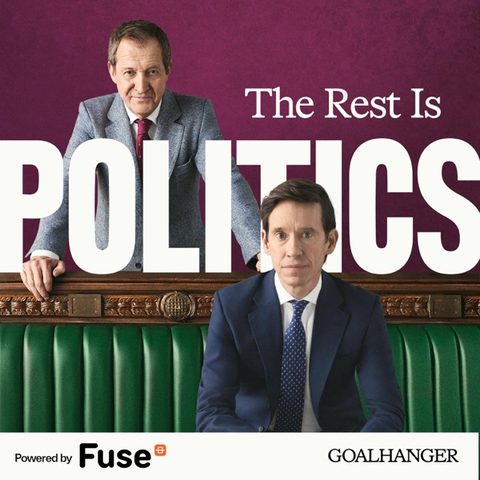
It sets out, in plain terms, the argument that Europe's security problem is no longer Russia alone but its reliance on an America that may be on Russia's side.
Transcribe your links. Paste a YouTube, Google Drive or podcast link and WhipScribe gives you the transcript.Transcribe a link →
▸Notable quotes
“it's like being trapped with a wealthy spouse who's abusing you in a house.”
Rory Stewart · at 20:30 — open in the transcript →
▸What this episode covers
Recording in Oslo after dinner with Norway's prime minister Jonas Gahr Støre, Rory Stewart and Alastair Campbell make the case that Donald Trump is no confused ally of Ukraine but a president working toward a Russian win. Their evidence is a cluster of recent moves: the disabling of the Starlink and Starshield systems Ukraine relies on for deep strikes and missile warning, sanctions relief for Moscow, a diesel deal, and pressure on Europeans to buy Russian gas. Seen that way, they argue, everything from the Oval Office humiliation to the Anchorage summit reads as one consistent policy.
The larger argument is about Europe's dependence. Stewart says European leaders still frame Trump as a burden-sharing dispute between friends, when the real threat is an America that can switch off satellites, weapons and software at will. He wants a deliberate, coordinated effort to work through each dependency, and he accepts that leaving will bring reprisals, citing the row over the EU reserving satellite spectrum for European firms. Campbell is more cautious, pointing to the price Mark Carney's Canada pays for speaking plainly, and wonders whether American voters might push back first.
The second half widens the lens to political violence. Campbell, who lives part of the year in France, describes riots he judges the worst since 1968, with no clear political demand and police who admit losing control. Stewart connects such disorder to a worldview he attributes to Stephen Miller and Elon Musk, in which war is the natural state of things. The hosts end on the car attack on Australian independent MP Helen Haines and a draft report on the toll public life takes on politicians, before Stewart offers Nordic and post-1945 Europe as proof that a better path exists.
▸Key takeaways
01Rory Stewart and Alastair Campbell, recording in Oslo after dinner with Norway's prime minister, argue Donald Trump has sided with Russia over Ukraine.
02Ukraine relies on US satellites and intelligence for deep strikes, so the Starlink and Starshield switch-off also blinded it to incoming Russian missiles.
03Alastair Campbell cites a figure that 85% of objects orbiting Earth are controlled by Elon Musk, the near-monopoly behind Europe's satellite dependence.
04Rory Stewart says Europe can only cut its US dependence by accepting reprisals, from the EU spectrum row to Patriot missiles and AI models.
05Rory Stewart closes in Oslo arguing that Europe's peace since 1945 is a miracle worth defending, not the naive illusion Stephen Miller describes.
▸Questions this episode answers
Q1What did Rory Stewart say about the Starlink switch-off in Ukraine on The Rest Is Politics?▾
Rory Stewart said Ukraine still depends on US satellites and intelligence for its long-range missile and drone strikes into Russia, and that the US had effectively crippled the Starlink and Starshield systems it uses. He said the bigger danger was that Ukraine could no longer see Russian missiles being fired back. He read the move as pressure on Kyiv to stop striking Russia, and said reporting showed Elon Musk had urged it and Trump had signed off, despite denials from both.
Q2Does Rory Stewart think Donald Trump is on Putin's side?▾
Yes. Rory Stewart argues Trump has been on Putin's side since taking office in January, and that this is the only reading that makes sense of the Oval Office humiliation of Zelensky, the Alaska summit, the satellite switch-off, sanctions relief for Russia and pressure on Europe to buy Russian gas. He says Trump's promise to end the war in 24 hours only works if the plan is to give Putin what he wants, and that many Europeans are still in denial about it.
Q3What is Rory Stewart's abusive spouse analogy for Europe's dependence on the US?▾
Rory Stewart compares Europe to someone living with a wealthy, abusive spouse who asks how they would ever cope on their own. He concedes the spouse has a point: Europe would be worse off building its own Patriot missiles, satellites and AI systems. He argues the dependence is now a threat to national security in itself, so Europe has to plan 10 to 15 years ahead and leave anyway.
Q4Why does Rory Stewart back the EU reserving satellite spectrum for European companies?▾
Rory Stewart calls the EU the only part of Europe thinking systematically about US dependence, and backs its plan to reserve radio spectrum so European companies can talk to their own satellites instead of selling it to American or Chinese firms. He says the US would never surrender that kind of sovereignty itself. He accuses Musk of getting the US ambassador to threaten repercussions, and says Europe has to accept that cost.
Q5How does Alastair Campbell compare the France riots to 1968 and the gilets jaunes?▾
Alastair Campbell, who lives in France part of the year, calls the riots far worse than the gilets jaunes protests and the biggest disorder since 1968. Unlike 1968, he says, they have no clear political message. He lists Limoges, Marseille, Lille, Nantes and Lyon among the places hit, and notes that the police admitted losing control. He expects Marine Le Pen to benefit, and says Russian and Iranian bot networks are amplifying the unrest online.
Q6What did Rory Stewart say about Stephen Miller's view that war is the natural state of the world?▾
Rory Stewart said a senior American official told him that Stephen Miller, and to a degree Elon Musk, believe war is natural and peace is not. On that view the post-1945 order of cooperation and rules was a naive dream, which explains their support for nationalist parties like Le Pen's in France and the AfD in Germany. Stewart argues that when such figures talk of civil war, they are trying to bring it about.
Q7What did Alastair Campbell say about the attack on Australian MP Helen Haines?▾
Alastair Campbell said Helen Haines, an independent MP from Victoria, was out without security when a driver hit her and then reversed into her, which is why people think it was deliberate. She was flown to hospital and has lost a leg. He linked it to a draft report called Fit to Lead, due in Canberra, which finds politicians suffer more depression and anxiety than emergency service workers, with social media a major driver.
Our own transcript of the public episode, with a timestamp about every 90 seconds. Tap a timestamp or the link button on a paragraph to copy a link that opens this page there.
0:00During the four years plus of this wretched war in Ukraine, Vladimir Zelensky has had some good weeks and he's had some bad weeks as he's tried to stave off the existential threat posed by Putin in Russia. By any reckoning, last week was a bad one, near non-stop military assault from Russia on civilian infrastructure and civilian life. But perhaps even more worrying, the clear sense from diesel deals and sanctions lifting, satellite switch-off and relentless anti-Zelensky rhetoric that Donald Trump is now firmly on Russia's side. That he wants Ukraine just to give up so that he can get the oil price down in the medium term and he can do big business deals with Putin in the long term. Today, Zelensky is in Norway as he carries on his
0:42relentless campaign to try to keep the Allies on side. Rory and I are in Oslo as well, and last night we were able to have dinner with Norway's Prime Minister, Jonas Garstora. Like all European leaders, he is facing this extraordinary challenge. How do you keep Europe safe while we have this aggressive Russia to one side and unreliable America on the other? And what role does Ukraine's success or failure play in answering that key question? This episode is powered by Fuse Energy. Most energy companies are counting on you doing absolutely nothing, not questioning what you're paying, not switching, just letting your tariff roll on, which is costing you hundreds of pounds every year. But the apathy goes deeper than our bills. We've almost given up on energy itself.
1:29We seem to all be accepting energy's expensive, the system's outdated, but that complacency is costing us. Fuse Energy does not accept that because the energy transition is not something that just happens somewhere else. Fuse is building an energy company which is designed to bring down the cost of energy. And right now its tariffs are up to £100 below the Ofgem price cap. So switching isn't just about paying less, it's about expecting more from your energy company and it only takes you three minutes. Switch to Fuse at fuseenergy.com slash politics. Use the code politics and you'll get a free Trip Plus subscription allowing you to hear all the extraordinary members content that Alistair and I are now producing for you. Visit fuseenergy.com for full terms and conditions.
2:14Hi, this is Gary Lineker from Goal Hangers. The rest is football. This episode is brought to you by WISE. It's only when you start moving money between currencies that you really think about the exchange rate, the fee, and what might be hidden away in the small print. Whether you're living abroad, paying someone overseas, or just trying to manage your money across borders, you want a fair exchange rate, an easy transfer, and no surprises along the way. WISE keeps things simple. WISE is a smart way to move the currencies you need around the globe. It works in more than 160 countries and with over 40 currencies. Most transfers arrive instantly. Wise uses the mid-market exchange rate, like the one you see on Google,
2:57with no markups or hidden fees. So when money needs to move, you can see the rate, know the fee, and get on with it. Join millions saving billions on hidden fees by downloading the WISE app today. Be smart, get WISE, T's and C's apply. This episode is brought to you by NordVPN. We work out ways to protect ourselves from unwanted things every day. Okay, Rory, how do you protect yourself from small talk? I say, very good to see you. I've got to get on to get my kids from school. Yeah, you also have another one that you use quite a lot. You say, I must go. I'm on Jordan time. That's good. I'm on Jordan time. I like that. OK, how do you protect yourself from arguing with your co-host? I just watch you argue with other people.
3:45No, I have this tactic when I think I'm losing my temper, I just rub my thumb and my index finger together, that's what I do, and I just calm down. Yeah, that's cool. And how do you protect yourself from online scams? Well, the answer is I find NordVPN useful for that. It's not just a VPN app. They've built in next-gen antivirus block scams, phishing attacks before they reach you, so you can carry on knowing you're secure. To get the best discount on your NordVPN plan, go to nordvpn.com slash restispolitics. You'll get four extra months free on the two-year plan, plus a 30-day money-back guarantee. The link is in the episode description. Welcome to the Restless Politics with me, Rory Stewart.
4:29And me, Alistair Campbell. So today, Rory and I in Oslo, we're going to be talking about Ukraine. We're going to be talking about how Zelensky deals with the current situation, where it looks to all and sundry like Trump is totally on Putin's side. We're going to be talking about the horrible riots in France. And we're going to be talking about another horrible incident, I'm afraid, in Australia. Well, listen, firstly, hi, guys. Two middle-aged men in a bedroom together. Don't get the wrong idea. Please don't. We're in Oslo. And we are both, as Alistair just said, just out of having dinner with the Prime Minister of Norway. Actually, a really impressive guy. Please listen to Leading if you want a stronger idea of his ideas, and a real fan of
5:09the show. Let's start though, Alistair, back with where you were with Ukraine. So one of the most dramatic weeks in Ukraine since the war began. Friday, Saturday alone, 337 Russian drones coming over 15 power plants hit, 500,000 people without power. Similar numbers of drones the following day, ballistic missiles coming in, counter strikes by the Ukrainians, including ground drones going into pipelines, drone warfare more and more central. So first time we've seen this week, a report of a soldier being evacuated by a drone, 100 kilograms picked up by the drone, flown from 60 kilometers away. So all that tech story happening, but the biggest story is the political story, which is the story around Trump, Musk, and the relationship to Starlink and Starshield.
5:57Because the Ukrainians are totally dependent still on US satellites and US intelligence for their deep strike. That's both their missiles going into Russia, and also their drones flying at distance. It's the American systems that allow them to do a lot of that deep strike. And suddenly, this week, the Ukrainians discovered that the Americans had effectively crippled those systems, making it not just impossible for them to strike, but much more worryingly, they were no longer able to see when the Russians were firing missiles back. And Zelensky spoke up pretty quickly because it was very clear to him that this was part of Trump's pressure on Ukraine to get them to effectively give up on their strikes
6:43against Russia. And we had a classic denial from Musk and then a denial from Trump, both claiming it hasn't happening. Extraordinary statement from Marco Rubio, the Secretary of State who turned out apparently not even to know that these American systems were on the ground in Ukraine. He kept claiming Starshield wasn't there and it was only Starlink. Finally, this has all been unpicked and some great reporting has revealed that Musk did indeed lie. He had indeed, it seems, put pressure on the White House to do this and suggested it and that Trump had signed off on it. And it's another sign of the case going through the court at the moment. I think the big revelation for me was Zelensky saying just in the last two days,
7:32we might be able to win this war if we're just against Russia. We cannot win this war if the United States and Russia are allied against us. And this is the first time I think that Zelensky has been explicit about the possibility that Trump is not a deluded, slightly incompetent ally of Ukraine and Europe against Russia, which has been the story many European leaders have and trying to explain that maybe he hadn't quite understood and he'd got national security wrong. We needed to explain the borders to him and give him the history. The more consistent view, which is probably what's been in Zelensky's heart for a very, very long time now, is that Trump has been on Putin's side from the beginning.
8:20And that's the best way of making logical sense of everything from the humiliation in the White House, through to the meeting in Alaska. And now finally, to the reason we're doing this, which is the decisions to disable access to Starlink, Starshield, satellite intelligence and lift the sanctions on Russia, while trying to actually put pressure now on Europeans to buy Russian gas. Well, and what we've said many times before is that if Trump wasn't a Russian agent, what would he do different? Now, that is the extreme sort of version of what might be going on here. But it feels more and more like he wants Ukraine to lose. He wants Russia to win. He wants to talk peace. But actually what he's about for the
9:06medium and the long term, medium term, short term, get oil prices down for the midterms. I think it's probably too late for that, but that's what he wants to do. Ridiculously blames Zelensky for their rise in the first place. And we all know that it's about his decision to, with Netanyahu, to attack Iran. But what we've got today, and I've just been doing an event talking about this with the American journalist, Susan Glasser. And what I find incredible about this is that we're all, we get our hopes lifted or I sense people's hopes are being lifted. Oh, well, this might be some big peace deal on the occasion. We're in Oslo where the Oslo Accords were. What's happened is that two very effective government leaders,
9:45Jonas Gastor, who we saw last night, Alexander Stubb, president of Finland, are giving it a go, are trying, see whether they can talk to Zelensky. Witkoff is here. Apparently, Kushner, Jared Kushner's got flu and he's going to join by video. But my money is on Witkoff going from here to Moscow. And going from here, he will hope, and I think Trump with hope, with a message that Zelensky finally gets the message. But it's perfectly clear, Zelensky is not going to get the message. If it involves, Zelensky has to say that we give up. You can't give up in these circumstances. So I think what Europe is trying to do is basically say, look, we've got to stay with you for the long term. Now, one of the things that we talked about last night,
10:30and you and I are both very, very passionate supporters of Mark Carney and the middle powers vision and all that. But what you're seeing, you know, in another interview we've done, Kevin Rudd, which is coming out in the next few weeks, where even with somebody like him, a former prime minister, who now runs a big sort of American-Chinese think tank, they can't actually say what they really feel about Trump because we are still so dependent on America. And I think what we're seeing here, the event I was at this morning, I don't know, you probably know this because you follow this stuff more closely than I do. I had this extraordinary stat, 85% of the objects flying around space at the moment are controlled by Musk. 85%. This kind of near monopoly. And as you said,
11:17we don't know how the switch off went on the other day, but we do know that it reminded Zelensky, you can't win this without us. And that's effectively what he's saying. So how do we keep Trump, and I think it is Trump, not the American administration. This is very much Trump. You talk to the American military, you talk to the American spooks. They are not in the same place, but he's the president. He can tell them what to do. So I don't find this a very hopeful moment. I find it a fascinating moment to be here. I find it a really interesting moment. But I just feel for Zelensky about what he's having to try to do to keep this show on the road. So I think the thing that keeps striking me, it doesn't matter
11:57whether we're talking to Kevin Rudd or we're talking to other friends, is that they're so used to America being an ally, and they're so aware of America's extraordinary power, that it's almost impossible for them to really not only say, but acknowledge themselves how much things have changed. I mean, they're not preparing for a world where, as Zelensky says, the US might ally with Russia effectively against Europe and Ukraine. They can't even process and contemplate it. They couldn't contemplate a world in which the US could ally with China. So when you talked to them about middle powers or whatever you want to call it, de-risking, de-leveraging, hedging, trying to be less dependent on the United States, what is the threat that they're trying to deal with?
12:50And I think in their minds, they still think about it as burden sharing. There was an amazing bit of what I think would be called gaslighting, which is when the Trump administration came in, they very successfully managed to convince a lot of Europeans that what Trump was doing is perfectly reasonable. He was just saying, you know, you're not spending enough money. And burden sharing is we're all on the same side. We all agree, you know, who the good guys are and who the bad guys are. We're with the West, we're with NATO. We just want you to pay a bit more money because we're fed up with paying the money. And Elbridge Colby would have said, you know, you focus on Europe, we'll focus on China. But we all agree, obviously, that Russia's
13:28an enemy. We're on the European side against Russia. We all agree, and I think this is the most fundamental thing, that what Putin did in 2022 changed the world, that he mounted a major invasion of a European country, first time really since the Second World War, that we all thought we didn't respond strongly enough with Crimea in 2014. And this is almost everything that the world order was about. This is why international borders matter. This is the existential security of Europe. This is tens of millions of European citizens being invaded. So the story would have been, the US understands all that, of course. They just want us to pay more. And the assumption would have been they want us to pay more, but they want us to succeed. Right? So they're going to get us to pay the bills,
14:15but they're still going to provide everything they can. And by the way, paying the bills means paying a lot of it to them for equipment, which at the moment is not being delivered. Absolutely. Because the assumption that we would have had is, okay, they just want us to pay the money. So we'll put up 50 billion euros or whatever it is. We'll buy American defense equipment. The Americans will obviously keep the satellites up in the air and the intelligence and we'll continue to work with NATO command structures or American generals in Germany. We'll get this done together with Europe paying. What's become clear is I don't think that was ever really the way that Trump or Vance thought about it. If you go back to that
14:49first meeting that we covered, the White House famous humiliation Slensky, they keep saying, we have all the cards, you have no cards. And what I think they mean by that is they believed the whole thing depended on the US. And although they were pretending what they wanted is for Europe to pay, what they actually subconsciously seem to have wanted is for Europe to fail. They imagined that Europe couldn't really replace them. And they thought as Europe failed, that would force Zelensky to accept Putin's terms. And this whole story about, I can solve it in 24 hours, only makes sense if you believe like Trump, there's a pretty, pretty obvious thing I can do here. I can just give Putin everything he wants. Give him peace in Ukraine, have a puppet government in Kiev.
15:30Ukraine doesn't join NATO, doesn't join the EU. Get it done in 24 hours. How do I do that? Cut the legs out from under Ukraine. We had that extraordinary meeting a couple of weeks ago with Kellyanne Conway, who was talking about this amazing relationship that Trump has built up with Zelensky. I was talking to somebody else who's American, who said that actually, the reason why, and she was saying that the reason why that meeting with Putin ended very quickly in Anchorage was because Trump was not putting up with his nonsense. I've heard a completely different version, which is the meeting ended quickly because Putin was not happy that Trump was unable to deliver Zelensky to the place where he said he would. And so I think what we're seeing now, I could be wrong
16:13about this, but I think what we're seeing now is the latest chapter in that story of trying to force Zelensky to do something that he knows in his heart he can't do or if he does he probably loses his life and he might lose his country and that's why i i think look i think it's great that yonas castor and alex understood it there but i really worry that this is just like another chapter in the same game and do you i mean put your cards on the table when when you hear them say listen we can't really decouple from the US, we're just too dependent on them. Is there not part of you that thinks that strategically in 15 years time, we might conclude that that was an error? That the writing's on the wall? I mean, that every week almost, we're reminded of why we need to decouple from the US. We'll get it when they switch off Google
17:05and Microsoft accounts from the International Criminal Court. We'll get it when they don't sell Patriot missiles. We'll get it when they switch off the Starlink system. We'll get it when they stop access to AI platforms. I would have thought it should be clear to everybody, the writing's on the wall, that it's intolerable. It's intolerable to be this dependent on a country that can do this to you. And nobody should ever allow themselves to be trapped like that. But we have allowed ourselves to be trapped in part by refusing ever to accept that it might come to this. Now, whether that's naivety or whether that is just that we had assumptions about the United States for what it is and what it represents, which have been blown apart by,
17:47and not just by one guy. In fact, this event I did with Susan from the New Yorker, she was saying that he's the climax of a process that actually in many ways predates him. She actually said, look, Obama didn't like you guys very much. Now, interestingly, she also said that most Americans actually do still believe in NATO, support Europe, like Europe. But look, I think it's just such a tough thing to do. You imagine right now, I saw this interesting thing, Blaze, the head of, Blaze Metrovelli, head of MI6, she did a, I don't know if you've seen, she's done a video today, calling, it was almost Lord Kitchler, Lady Kitchler. She's calling on anybody who's really tech savvy to apply to join MI6. Why? Because this tech world is where we are going to have to get much, much better at what we
18:36do. And I was watching that and thinking, wow, there's a head of MI6 coming out in public and saying, we need your help right now dealing with all this this tech stuff and you keep saying you said this several times in your in your mini series we're probably third in the world the uk but we are it's like saying there's barcelona and and manchester city or let's not say manchester let's say bion mun. And then down here is, well, Bodo Glimps down the road. We're third. Yeah, exactly. So how are we going to, we're going to try and fill that gap. And likewise, on the military side of stuff, we're going to try to develop. So you've got the whole thing of there are different relationships developing.
19:21Canada's involved in this, Norway, UK, you talked about the frigate deal. These things are happening, and about the frigate deal. These things are happening and they're maybe buying time. But I think if we were suddenly to start to speak about Trump as leaders, if Andy Burnham and Mertz and Yastor and stuff were starting to speak about Trump the way that you and I speak about Trump. And that Carney does. And that Carney does. But I think Carney is unique. Carney is unique for all sorts of reasons. One, he had to say those things in opposition. That was how he became prime minister. There was this existential threat that was posed by Trump, 51st state. And he had to say those things, and he's carried on. Now, has it damaged Canada? Yes and no. Canada's actually, I mean, Canada at the moment,
20:07I mean, there he was on the front page of The Economist last week, you know, with a maple leaf in his mouth looking like a hero. He's been mentioned several times at the things I've been doing today as a hero. But Canada is paying a price at the same time. Now, so are the Americans, but it's a much smaller price. But I guess there will be a huge price to pay. And maybe my analogy is massively overdone. I keep coming back to this idea that it's like being trapped with a wealthy spouse who's abusing you in a house. And when the wealthy spouse says effectively what I feel Mike Pompeo is saying or Marco Rubio is saying or Elbridge Colby said very explicitly, which, you know, all this talk about middle-class waste of time, they're never going to be able to
20:48do it. The spouse is saying, well, you may not like it and I may be beating you up, but what are you going to do? You're going to get your own house? You're going to get a job? Do you know how difficult it's going to be out there? And of course, the spouse is right. I mean, the US is not kidding. We're going to be worse off, right? We were going to end up in a situation where we're going to have to build our own Patriot missiles. We're going to have to get our own satellites into the sky. We're going to have to think about how the hell we get AI systems going in the absence of US. We might even have to think about critical minerals, but if the direction of travel is inevitable, which is the United States, and our dependency on the United States is now a critical threat to our national security, which is what's being demonstrated in Ukraine. And what do I mean by that? I mean that we have, I believe, I think you and I agree, an absolutely vital interest in protecting ourselves against Russia. Russia winning in Ukraine would be catastrophic for us. I mean,
21:46it hands over tens of millions of Ukrainians onto the Russian side. That's the biggest, most fearsome army in the whole of Europe that's containing Russia suddenly removed from the picture. So, if we believe that, and the United States starts trying to weaponize our dependency on the Russian side, which is what they're doing. If they're switching off Starshield, if they're beginning to lift sanctions on Russia, then I think we have to see this in a completely different way. And we have to think 10, 15 years ahead. Well, but I guess what they're thinking is that they maybe will say they are thinking 10, 15 years ahead. They know that this may be the direction of travel and that it may not be repaired even after Trump. But at the same time, practically, logistically, they have to keep him
22:31as on board as they can. You and I have been saying that for some years, we think Trump is basically on Putin's side. And yet, until the last few days, I've not really felt that Zelensky has been completely thrown under the bus. OK, I'm beginning to feel that it is about to be thrown under the bus. And therefore, I think that I think European leaders have to keep doing what they can. But my sense is that it's really weird that people only now think Zelensky has been thrown under the bus or that they're only now. I mean, I think The Economist has finally produced a front cover with Trump dressed in a Russian hat. No, it's The New World. It's The New World. It's you. I'm so sorry. I've given you the credit.
23:14It's Agent Orange. You don't yet have the subscriber base yet quite at The Economist. But yeah, The New World has done that. So I'm thinking, why is it taken to now for people to point out what has seemed very obvious to me for a year and a half? That he's on Putin's side, right? And that he's thrown Zelensky under the bus from the beginning. That's what he was doing from January when he came in. So, that makes me think that we're in denial. It's not that I was wrong and they were right for the last 18 months, but something's changed in Trump. I don't think anything's changed in Trump. I think his policy has been pretty consistent. In fact, once you've got that, almost everything he's done since January that he came
23:55in, it makes sense, right? In which case, my guess is they're still in denial. That those same features that are making them take so long and making all these people be like, whoa, is it possible that Trump is actually is actually not on on zelensky's side i don't think they're saying that but what do when you say the writing's on the wall it's a new world in practical terms what does that mean about let's what does that mean about let's put it right here now what do you and scostor and aled understood? What do they say to Zelensky today? What do they say to Witkoff today that doesn't actually make things considerably worse for Zelensky? So, I think you're probably right that in the room with Witkoff and Kushner, you
24:41try to be as constructive as you can. There's no point having a row with them. I don't think you want to be doing the Mark Rutter, daddy, daddy, falling over backwards. We've gone far beyond that. You need dignity, you need clarity, you need calmness, which I'm sure they can deliver. But the big question about denial or action is, is there a coordinated intentional project from Canada, Norway, UK, EU, that goes through the 10 dependencies on the US and works consistently 24 hours a day, seven days a week, to deal with those dependencies? Because what worries me is they're still hoping they can have their cake and eat it. They're still hoping that they can talk about no institutions, multiple flexible relationships, we'll do a frigate here, we'll do a submarine
25:31there and that will somehow be enough. And that isn't enough. It still predicates it on the assumption that the US is on side. And the real test this week is around the Starlink systems. So as you say, sky's full of Elon Musk satellites, 85% of them, not ours. And actually, there's been some terrifying reporting that the Russians now maneuvered one of their satellites alongside the big American satellite, which is a very costly, dangerous maneuver they've done. So space war seems to be being threatened, right? And Europe has now announced, and I think the European Union are probably the smartest on this. They're the only people who are really thinking systematically in Europe about this, that we need to reserve the spectrum, in other words, the radio frequency for
26:15European companies to be able to communicate with satellites. And we shouldn't be selling it to the Chinese or the Americans, right? Seems to me to be a normal. The Americans certainly wouldn't do that, right? Not that, I mean, this is what's so hypocritical about it. The Americans would never ever contemplate surrounding their sovereignty in this way. They would never allow any European company or country to dominate any element of their defense and security in the way that they demand to dominate us. And when we try to do it, suggest politely that we might do this, Musk immediately contacts the American ambassador who says there will be unbelievable repercussions for Europe for daring to contemplate having our own independent spectrum. And Musk reminds us that we can't
26:56dare to do it because if we do that, he might switch off Ukraine. Well, that's a great thing to say when he's just switched off Ukraine and just reminded us why we need our own independent spectrum. I mean, it cannot be the case that we could accept a situation bullied by an American ambassador saying we're ever going to be in that you know are going to send them off the deep end. So maybe what you're saying is we do have to send them off the deep end and see where that goes. But I'll tell you what I think, something that happened recently was when, and God knows how he's been so calm and so patient and so amazing as he has, but Zelensky has been extraordinary. But he did that interview with the FT at the weekend when all this sort of,
27:41you know, Trump's ridiculous energy ceasefire, the diesel thing, where he was basically giving Putin the right to earn more money for a pitiful amount of diesel that was actually going to go, then the sanctions. And Zelensky does this interview, and he probably, I'd love to talk to Mary Trump, who, by the way, if you think we loathe Donald Trump listen to his niece on leading this week and she's extraordinary she speaks so clearly about it isn't she she's thought about it so much and so what's the worst thing that you could have said to vote Donald Trump weak he said he was weak he was basically saying that Putin has got Trump where he wants him he's pushing him around now can you imagine the effect of that on Trump?
28:27Zelensky says he's weak. So I think we've seen a kind of an example of what would happen possibly if, let's say, Jonas Gastora came out and said, well, we're just going to have to learn to rely without the Americans. You can't say it. I don't know. And maybe you don't say he's weak but i think uh again um you're not going to be able to get out without risk and cost so let's take that styling example presumably like me you agree that europe was correct in saying we're not going to sell all our satellite spectrum to the us and chinese that would be insane particularly after what musk has just done, right? So what happens? The American ambassador goes ballistic, and America threatens reprisals. Well, are we going to take it or not? Yes, we have to, right?
29:14And that will be true for all of this. I mean, logically, the only way that you're going to get out of a relationship with a bully is through them bullying you. You're not going to be able to charm your way out. There's no way of saying, I mean, in the end, it's pretty black and white. Either Musk can buy your stuff or not. Either you're buying American Patriot missiles or you're not. Either you are putting pressure on American companies to make sure that we own the AI models they sell us rather than the US being able to switch them off or not. And I don't feel that these leaders are being clear enough about that. They have to have those fights. And we have a discussion about how you communicate the fights, have a discussion about how you sell it to Trump,
29:55but you're never going to make him happy because what you're doing is you're saying to a bully, I'm leaving your house. I guess the other thing that might happen is that the American voters maybe come to some sort of rescue. I mean, is it too much to hope? Because this, maybe I just don't understand America. Maybe I never have. But there's a little part of me that thinks this constant sucking up to Putin, this, and let's remember, Trump's ratings are as low as they've ever been. Putin's are even lower. The most popular politician, foreign politician in the United States, it's a toss-up between Carney and Zelensky. So the two people that he's been most vile about, rudest about, Claudia Schaumbom's up there as well,
30:38they're actually quite popular in the United States. So is it too much to hope that this constant sucking up to Putin and this pathetic attempt to blame Zelensky for the gas prices that are damaging them in the midterms, that actually it might backfire, that it could make things worse? Well, I think it's a really good question. And the answer is, I don't know any more than you do. A small plug though, as you're aware, I've finally got my American visa. So I'm off with the team. Take a lot of the restless of the politics team with me. I'll be in Clinton County, Ohio, moving down into West Virginia, Southern West Virginia over a week. So this is a huge opportunity to just say to anybody watching, do please get in touch
31:19because we're doing this road trip over the next couple of weeks through a lot of the country which J.D. Vance's grandparents grew up in, the country where he grew up in. These are areas which have gone back and forth between Democrats and Republicans and where we're going to be asking exactly these questions. So, if there are any listeners who have got ideas and would like to get in touch by email, we're going to be going down from Clinton County, Ohio, through Cincinnati, through Yorkstown, down into the McCoy country of West Virginia, down to Southern West Virginia. So any issues you think we should be covering, any people you think we should be meeting. And Izzy from our newsletter team is also going to be in Texas at the same time. So we'll be
31:58covering Ohio, West Virginia, and Texas can't cover the whole of the US, but at least it's Trip taking an interest in those parts of the US, but at least it's trip taking an interest in those parts of the country that we were not covering last time when we got into the election, to put it politely. To read our pieces in the newsletter, you can sign up on restlesspolitics.com forward slash newsletter. And I will be keeping in touch from a distance because I'm holding firm for the entire Trump term too, that I'm not going to the United States of America, a pathetic, but makes me feel slightly better about the world symbol. Just a couple of things on leading. I mentioned Mary Trump. She's the leading episode at the moment.
32:35Done a brilliant interview this week with Michael Lewis. Second time around with Michael Lewis, a fantastic writer. And he's written this book, Blockers, which essentially is about the deep state, actually the Trump deep state taking over what they claimed was the deep state. Deep state is a fascinating chat with him. So I look forward to that. Final point on Ukraine before we go, to do a bit of pedultery and do a shout out. For people who are interested in the day-to-day granular reporting, we don't often praise the Daily Telegraph for good reason, because we often disagree that it's politics. But Ukraine The Latest, which is their daily podcast, is really, really exceptional on the granular detail of this stuff. And it's almost addictive
33:15listening if you want to get a sense of what's happening moment by moment. I mean, they'll point out, for example, that as we're recording today, there was a strike at three in the morning, 11 in the morning, 11 at night, and what that actually means for people in Kiev at the moment. But they're also very, very good at getting the detail on the ground from the generals, from the commanders, and what's happening on the front line. And they are very worried this week. And we'll find, you know, by the time this comes out, we'll have known what Zelensky's done here today. We'll have known if Bukov has gone to russia we'll have known what that then leads to my final point is i mentioned last week
33:49this guy who sends me lots of quotes from american politics and in history this one comes from the the the the title of the the email said best president we never had nobody better qualified any guesses it's your friend hill Hillary Clinton, isn't it? Hillary Clinton. And this is exactly 10 years ago today. There was a Trump-Clinton debate. She said, Putin would rather have a puppet in the president. You won't admit that the Russians engaged in cyber attacks against the US. You won't admit that you encourage espionage against your own people, that you spout the Putin line, sign up for his wishlist, want to break up NATO, do whatever he wants you to do. I think right now he's doing what Putin wants him to do.
34:36Absolutely. But why didn't people listen to her then? And if it's right, and I think she probably is right, that he does want to break up NATO, what does that mean for people who still believe that the US, that they can, you know, we keep getting this line. You remember the famous cliche on NATO, that NATO is about keeping Germany down, the US in and Russia out. But if the US is on Russia's side, the strategy has to be Germany up, Russia out, and perhaps inevitably disentangling from the US. Okay, let's take a break. And then we'll come back, talk about France and Australia. Pretty grim goings on in both. Very good. See you then. See you soon. This episode is brought to you by Lloyd's Business and Commercial Banking.
35:19We hear a lot of talk from Whitehall about growing British business. We've heard about how business can drive change. Well, when it all comes down to it, all this affects what happens in workshops, offices, factories and high streets right across the country, because that is where the real growth happens. And Lloyd's are right there, supporting ambitious British businesses like yours, whether you're expanding, whether you're exporting for the first time or pursuing a new opportunity, you need the right foundations in place to support that growth, like a Lloyd's business account. Right now, you can get up to £400 in rewards when you apply for Lloyd's business account by the 30th of November,
35:552026. Search Lloyd's business accounts to find out more. Eligibility criteria and terms and conditions apply. A better help ad. Your brain has limited storage. So why is it still holding on to that embarrassing moment from years ago? That tough breakup? The conversation with your boss you keep rehearsing in the shower? If you could permanently delete one thing from your brain, what would it be? BetterHelp is an online therapy platform that gives you space to talk about what's taking up too much of yours. BetterHelp is now in network with more than 125 health plans, with many co-pays as low as $15 for eligible members. And if you don't have eligible insurance or live outside the U.S., you can still get 10% off your first month.
36:34Sign up and get 10% off at betterhelp.com slash restpolitics. Cost and coverage may vary. Ulcerative colitis and Crohn's disease symptoms don't pause for the moments that matter. That's why understanding your treatment options matters. Discover what's possible with Trimfiya. Guselcomab. Trimfiya is a prescription medicine used to treat adults with moderately to severely active Crohn's disease and adults with moderately to severely active ulcerative colitis. Serious allergic reactions, increased risk of infections, or lower ability to fight them in liver problems may occur. Thank you. to learn more about Tramfaya and visit tramfayaradio.com. Welcome back to the Restless Politics. With me, Alistair Campbell.
37:36And me, Rory Stewart, sitting here in our sauna. And I did actually go to the sauna yesterday. Did you? Did you go to the sauna? No, I didn't. It's quite a Norwegian experience. And then I had my pickled herring for breakfast. Lovely. So I'm feeling quite Norwegian at the moment. Okay, that's good, yeah. I want to know what you've been up to, because I've actually been out and about doing things, and you were never there. Well, I did an interview with the Empire podcast. Ah, okay. With our brothers in Goldhanger, brothers and sisters in Goldhanger. I also went for a walk in the park. Nice. Really lovely. Any nice trees for me? Lime trees. Really beautiful. Linden, running down to the Royal Palace.
38:08I bet you didn't take any pictures for me, did you? I didn't. I didn't. I didn't. I found a tree of the day anyway. Went to the Historica Museum. Excellent. What's going on? Anyway, okay. Anyway, while you've been working and doing all this earnest stuff, I've been enjoying Oslo. Excellent. Good, good. Okay. Well, we're going to begin with France, and it's a subject that Alison knows far more about than I do. He speaks beautiful French and lives in France part of the year. So, it's going to be more my interviewing him. But I'd also like to say a huge thank you to the number of listeners that got in touch, members and non-members who wrote in. Holly, for example, who wrote in giving eyewitness accounts of what she was seeing, describing two things in particular. One of them is other groups joining the movement as the riots continued.
38:50So the sense that once something gets going, many other groups, they might start as idealistic students, other people get pulled in. And the second is her strong sense that she felt the policing was far too violent too early, and then far too soft once they lost control. So a great deal to get into. But let's turn to Alistair on the subject of France. This actually relates to some extent back to what we're talking about in Ukraine. Because, of course, one of the messages that both Putin and MAGA want to put out is this European civilizational erasure. Now, these riots are terrible. They are truly, truly terrible. People talk about 1968, but in 1968, there was a fairly clear political message at the heart of it. It strikes me that
39:33this is just a different collection of people and groups who've just gone out and decided to burn the place down. And they've done it at a time. If people want political change, I mean, whether we like it or not, political change is coming. So what it's going to lead to, I just don't know. And you've got – so Macron actually was fairly quiet at the start. He got a lot of criticism for being at Celine Dion's concert as the school thing was going on. Then he was somewhere else when the broader rioting started. But he did an address to the nation. And he's in the Gulf now, I think. Yeah, he's in the Gulf. He's been criticised again for being out of the country. But I think – and I don't know about these address to the nation. And he's in the Gulf now, I think. Yeah, he's in the Gulf. He's been criticised again for being out of the country. But I think, and I don't know about these address to the nation things.
40:07I mean, you understand why presidents want to do it. But I think when part of the argument is that the word of the leader is no longer being listened to, I'm not sure they have quite the way they used to. But I guess presumably if you'd been on the phone to him when that was happening, you might have been tempted to say, get out to the site of the riots, get to Limoges. Straight away. Yeah. Straight away. I think to sort of, you know, behind your desk in the Elysian, it's very much the sort of presidential, French presidential style. But I think where this leads to, I just don't know, because, you know, the Home Office guy, the Interior Minister Nunes, offered to resign. Macron refused his resignation.
40:44A lot of people within the government are blaming Mélenchon and his hard left party for having sort of cranked it up. He's blaming the government for saying the police have been too violent. The hard right are saying that the police have not been tough enough. And it's just like, it just feels like a total mess. The level of damage is just off the scale. And I think there will be a majority in France who are just thinking, what the hell is going on? What do you think British people might be missing about this? We might immediately kind of jump, I suppose, to the London riots, maybe in the early 2010s is our best equivalent. But is it a bit different to that? Does it feel different to that to the French?
41:28This does feel different because, you know, you mentioned the, you know, I mean, Limoges. I don't think you've ever been to Limoges, but it's just, I'm trying to think of an equivalent you might go to. You know, would you go to, I don't know, Lincoln? Maybe Lincoln's a bad example, but I just think we talk. What Limoges is is a sort of fancy historical town. Well, it's just, yeah, it's just not, and it's, last time I was there, I'm not aware that it's sort of got terrible kind not and it's last time i was there i'm not aware that it's sort of got terrible kind of issues of race relations and immigration and so forth so i think you had a combination of they're like winchester or something maybe somewhere between
41:55the two somewhere between the two not bad yeah and of course and when you see i mean we had the whole thing with when you know notre dame burnt down but this building has been burnt down and there were people inside, by the way. They could have been killing people by doing this sort of vandalism. And then you had the looting stuff. And, of course, the looting is often done by people with masks on. You can't actually see them. But, honestly, you look at some of the stuff on social media, the racism that it's bringing out is just vile. So you've got the hard right, the hard left, the folks from the Bollinger who think, okay, a bit of disorder going on, I want to be a part of it. You have the football hooligans.
42:31Just to explain for listeners, the Bollinger is a reference to people living in deprived areas, often on the outskirts of major cities, often North African immigrants. Exactly. And what that goes to, this maybe is a difference to Britain. I do think we have done a better job of integration. Now, you might, you know, Nigel Farage listening to that would snort his head off and what have you. But I think we, you know, you go to parts of London. Yes, you get areas that are predominantly this race, predominantly this nationality, but in general it's mixed. Whereas if you go to Paris, you have a pretty affluent centre. The further out you get, the less affluent you become. It's pretty amazing when you drive through the suburbs.
43:15It's a very different world. Totally, yeah. And there are parts of London like that. And also some of the worst violence was in Marseille. Now, we know Marseille really well and love Marseille. It's an amazing city and does have an edgy reputation. But the violence there was really bad and the damage was really, really bad. So, Lille, you know, Nantes, Lyon, lots of these places that we know. And they have that kind of curfew. Is this worse than Gilets Jaunes? Oh, yeah. Way worse. So, it's going back to 68, really, to think of anything on this scale. The only thing I think about 68, I think the political cry was much clearer i don't know what the i think that this may be um it maybe does relate to some extent to what we've been talking about a lot recently for example with alan
43:56milburn where we're talking about it in terms of we now have a prime minister i think this is what why touch wood we might be able to avoid this is because i think there is a recognition that some of the complaints that have been made when you when you get through the violence and you get through the nastiness and the the horrible stuff the basic call is this is a country that is pretty wealthy but it's going broke and we're the ones paying the price right i mean the debt levels are off the scale yeah but it is if you go to you know i said i said to you in the summer we spent our whole time running into americans and saying we can't believe how amazing this place is right so there is that france that's still there that is affluent that is rich that is culture and all
44:38that stuff but there are substantial numbers of people who don't feel they're part of that and i suppose the other cliche you might hear is that there is a French tradition of this kind of violence. I mean, even as a kid in the early 80s, I was very struck when I first saw the CIS, the kind of riot police, and the sense that they sort of have people who deploy with tear gas, plastic, and there's that. So, there might be a sense that there's something in French, I don't know, I'm saying like a sort of French public intellectual, but there's maybe some French culture which is different from Germany or Britain when it comes to this kind of tradition of demonstration and otherwise they wouldn't have those kind of police forces.
45:20But I think there is something different about this and I can't quite put my finger on it. And the truth is the police lost control. They've admitted they lost control. Now, normally, in what, as you say, is a state that is capable of some pretty tough policing when it has to, the fact that they can admit that there were certain parts of the country where they lost control, and not just in Paris, by the way that is a big big statement to make and does it relate to the kind of economic challenges and the shredding of public services which we've also had and of course the worst thing of all is it totally plays into the hands of these these people in the in america who want to say that we're that we're screwed and you know we're
46:01going nowhere and presumably into the hands of Le Pen strongly, because Le Pen can now say this country is going to hell in a handcart, use all the social media to focus on people coming in from the Bologna and say, this is why you've got to vote for me. Whereas the left are saying you've got to vote for us because if you don't, you're going to have this kind of right-wing police state. I think the other thing that's, you know, we've got to keep coming back to this because it happens to be true when we discussed it with Andy Burnham, Russia and the referendum. And I've never said they swung the referendum because we don't know. But what they do, both Russia and the Iranians, is they are very, very good
46:38and they spend a lot of money on it. And I was a bit disappointed, actually, Ken McCallum, the head of MI5, when he said, you know, we shouldn't make these Russian bots feel like they're 10 feet tall. Slightly trying to play it out. They are all over this. They are all over this. And they are basically the sort of misinformation, the fake videos that get put around about what's going on. The American angle on it, I think, is very interesting because I was talking to a senior American official and I was saying, why do people like Stephen Miller think it's sensible to support ethno-nationalist movements like Le Pen in France, AFD in Germany? Why do they think somehow getting Germany to rearm and then handing it over to extreme nationalists is a sensible way of
47:23thinking about European policy? And he said, oh, no, no, you've got to understand that these people, Stephen Miller particularly, but actually it's pretty true of Musk and some of the others, think the natural state of the world is war. Stephen Miller sometimes refers to Israel as being the natural state, that the future of the world is understanding that peace is unnatural, that war is natural. And so, when Musk says there's going to be a civil war, fight, fight, fight, which is what he says to Tommy Robinson and the big crowd in Trafalgar Square. And when Stephen Miller says the lesson of history through time is power, violence, force, they are trying to bring into creation the world that they believe is the natural world.
48:06If you were to say to them, what is this idea of armed, hyper-nationalist Germany? They would say, that's the natural world and that the whole world since 1945 was a pacifist dream. It was just an illusion, a naive illusion that you could have peace, cooperation, France and Germany not fighting each other, peace dividends, rules-based international order. So, they delight in this stuff. I think that's what I'm sort of trying to get to. And I think in a sense, it's probably true for Russia too, that they're not describing the situation when they say there's civil war, they're willing it into existence. Yeah. I don't suppose Stephen Miller will be going to the front line though, will he? No. Probably not.
48:49No, he won't be doing that. But they will be thinking, this is what we always thought. And I think Peter Thiel and others, because their worldview is anarchy, mayhem, strong men. And I think the biggest challenge that Europe have opposed to them is this, you know, this sort of place it's like we are now. This idea of sort of peaceful, scanty Europe is a complete offense to them. But also, I was talking to an American who's there, says that the American media is just, I mean, it's all France, France, France, France vibe. You know, they don't actually talk about us that much anymore. But this absolutely fits the agenda. And of course, I can remember during the foot and mouth crisis when we had to put together a
49:36proper targeted strategy because the news was covering foot and mouth disease in the UK and just showing these pictures of cows being burned. Yeah. Okay. Funeral pyres. Smoke. Exactly. All that stuff. And we suddenly started getting messages from the tourism industry saying we're having a collapse here because everything on the television is just, you know, and it was Britain's on fire. Yeah. And now they're saying, you know, France is, the whole France is kind of rioting. Now, the riots are terrible. But I think the delight that they take in this is kind of weird. But it speaks to what we were talking about in the first half. God, this is turning out to be quite a grim episode, Rory. We've done Ukraine being sold out, France, riots, and now we're talking about Australia.
50:21Can I just come in on that? Because before we get into Australia, I think the balance is remaining able to explain an alternative vision. And I think in a way, holding on to two things that we talk about a lot are very helpful. One of them is holding on to the idea of what Europe in the fullest sense could mean. I don't just mean the European Union, but actually the European Union is a lot about it. What it's been since the Second World War in terms of values, peace, stability, and why that matters and democracy matters. And that there is an answer to France and there is an answer to Germany. And there's an answer to a lot of things we're talking about with Norway, Ukraine, which is that we've done this, we know how to do this, and we've done it very successfully for 70 years.
51:08And then the other thing is, one reason I'm so inspired by Carney is in a sense, it's optimistic. There's a tendency to portray the middle power stuff as though it's terrifying. And that's what I think the Stephen Millers and the Musks as well want to do, which is to say, it's a world of American domination, civil war, and if they have their way, probably third world war. I mean, you can begin to see people saying the third world war has begun already, right? Ukraine, Iran, Yemen, goodness knows what. Africa, Middle East. Exactly. We are in the third world war. And the optimistic answer is to explain that there is a path through that. It's a path through risk, it's a path, costly, but a bit of optimism. Anyway, on that though, very sadly, somebody who we both
51:47know in Australia, horribly independent MP, and maybe we get into that a little bit because that is something which my sense, at least from Australian friends getting in touch over the last 24 hours, struck a huge chord and connects to Bondi Beach. This sense that after Joe Cox, Australians often felt that they were rather sort of exempt from this and this kind of violence. Well, they thought they were exempted from the right-wing populism and Pauline Hanson's doing pretty well. They thought they were largely exempted for this kind of violence. Funny enough, on Monday, I think it was, I was doing an online event with McKckinnon and they run there's this leadership course that they do for would-be politicians and when i go to can when i go to australia next month the reason that i'm
52:32doing all sorts of things with the book and speaking and stuff but the reason that i first agreed to go was for an event in canberra where there's going to be this big, big report published about what politics is like, and looking at issues like mental health of politicians, looking at issues like what it is actually like living under the sort of threat that politicians get, particularly women. I've only seen a draft so far, but this report, Fit to Lead? Essentially, it's really looking at what we are doing to our politics because of the way that we treat our politicians. So Helen Haynes, politician from Victoria, out and about, no protection, no security, that stuff. And somebody drives into her. And the reason why people think that this was deliberate
53:20is because he then did a bit of a turnaround and he reversed into her as well. She was medevaced out. She's had one leg off. I think they're trying to save the other one. And it has a bit like, you know, we've had these moments, you mentioned Joe Cox, David Amis' death, Stephen Timms being stabbed. And people would also add to that list, Ann Whittakin was murdered. Yeah, exactly. And what's happened in Australia is they're having that kind of soul searching moment about this. But I think there is right around the world, and I'm afraid we're back to our friend social media. In this report, the draft of which I've seen, two things really leapt out to me. The first is when politicians are asked about, examined their mental health, they end up basically having more depression, anxiety than people who work in the emergency services.
54:13And the second thing is that their experience of people's connection with them is positive in the main. The minute they go into social media, they just see things about themselves and their families that they never want to see. reason this sort of kind of came at me like a truck was because in this talk that i did to these often young people who were all online in saying yeah if you think about going to boys do it you must do it it's like a you can change the world it's a great life there are yes there's horrors in it but there's a really real good reason to do it and i was thinking about them this morning they must be thinking god i really want to put myself at that risk. I agree. And add to that, I mean, we both knew Helen a little bit.
54:53Sorry, know Helen. I mean, she's praying for her recovery and the other Teals. But one of the things that struck me last time I was sitting down with them in Sydney is just how tough daily life as a politician is. Andy Burnham, I think reflects on this, that the relief he felt getting out of Westminster, I remember always feeling that when I got off the train in Penrith, kind of really cheesy, but my heart just lifted being out of that horror. But Jo Cox in her constituency, Helen Haynes in her constituency. Yeah, David Ames in his constituency helen haynes in her david ames in his surgery absolutely absolutely so you get the idea that everything's great in your constituency and it's horrible other thing i'd say is of course there is a pattern here
55:38but these are also very very different individuals and we don't know much about their motivation. I noticed that a lot of the Australian media is now going through his social media accounts, the man who's been alleged to have committed this. And you can see his posts. And he's very critical of Israel. He's very critical of loggers. He's pro-environmental. So who knows? And also his father has said that Helen Haynes was known to them. So look, there's no point speculating what his motivations might be. This is a very tough episode we've done today. We finished with a very wonderful Australian member of parliament now suffering horrifying, life-changing injuries in what is essentially a terrorist attack.
56:20We've talked about the rioting in France and the damage it's done, and also the damage it's done to the whole French social order. We've talked about Trump's betrayal of Zelensky in Ukraine. We've talked about a world that feels defined by terrorism and by civil war, and almost by World War III. Just to finish, we are also in a world where Alistair and I are about to go and do an event. And I can absolutely guarantee, because he often does this, that if he asks people in the crowd, stick up their hands, how many people's lives are going in the right direction, many hands will go up, the majority of hands. We are in Oslo. And I don't want to be one of these people holding up Scandinavia as a banner to the world. But it's pretty impressive,
57:03the societies that have been created here, but not just here. Even in Lithuania, in Romania, in many of the countries that joined the European Union, that the world since 1945 has been a miracle. The world since the accession into the European Union in the 2000s is a kind of miracle. And I hope we can keep coming back to how we stop the terrorists, the warmongers, the civil war terrorists from driving us there because it's not inevitable and we're sitting in a place that's a better world. And tomorrow on Question Time, we're going to be talking about the Israeli elections and all that they portend. We're going to be talking about the woman who has destroyed the one thing Anthony Scaramucci had going for him, a world record.
57:45We are going to be talking about Katie Zachariah, the short-lived White House Press Secretary, and we're going to be talking about pretty amazing, another undercover documentary, this one on ITV, about reform. All that and more in Question Time tomorrow. Including a little bit on children's books and a bit of a discussion about Alice's new book book out this week, perseverance. Look forward to seeing you soon. See you soon. Zepbound Terzepatide may be able to help. Zepbound is a prescription medicine used with a reduced calorie diet and increased physical activity to help adults with obesity or some adults with overweight who also have weight-related medical problems to lose excess body weight and keep the weight off.
58:37Zepbound is approved as a 2.5, 5, 7.5, 10, 12.5, or 15 milligram injection. Zepound contains terzapatide and should not be used with other terzapatide-containing products or any GLP-1 receptor agonist medicines. It is not known if Zepound is safe and effective for use in children. Don't share needles or pens or reuse needles. Don't take if allergic to it, or if you or someone in your family had medullary thyroid cancer, or if you've had multiple endocrine neoplasia syndrome type 2. Tell your doctor if you get a lump or swelling in your neck. Stop, ZipBound, and call your doctor if you have severe stomach pain or a serious allergic reaction. Severe side effects may include inflamed pancreas or gallbladder problems.
59:19Tell your doctor if you experience vision changes before scheduled procedures with anesthesia, if you're nursing, pregnant, plan to be, or taking birth control pills. Taking Zepbound with a sulfonylurea or insulin may cause low blood sugar. Side effects include nausea, diarrhea, and vomiting, which can cause dehydration and worsen kidney problems. Talk to your doctor. Call 1-800-545-5979 or visit zepbounce.lily.com Hi, I'm John Ray, your friend and jeweler at Shane Company. When you buy an engagement ring or fine jewelry gift from Shane Company, you get more than what you paid for. Our jewelry comes with our all-inclusive free lifetime warranty. It covers everything. There's no fine print. You'll get unlimited
1:00:01cleanings, resizings, and repairs. Plus, it even protects your engagement ring's center stone. We stand behind the quality of our jewelry, and that's our gift to you this holiday. Peace of mind. Because a friend knows the best things in life are free. Shane Company, your friend and jeweler. Prize Picks Packs are here. Rip digital packs and get real basketball, football, and Pokemon cards. Sell cards instantly for cash or ship them home. Prize Picks Packs gives everyone the opportunity to pull the one-of-one Cooper flag rookie card. basketball, football, and Pokemon cards. Sell cards instantly for cash or ship them home. PrizePix Packs gives everyone the opportunity to pull the one-of-one Cooper flag rookie card worth $8 million
1:00:30and the Pikachu illustrator card worth $2.8 million in packs as low as just $1. Download PrizePix and use code SPOTIFY to get $25 instantly in bonus packs when you buy your first $5 pack. PrizePix. Run your game. 18 plus eligible areas. Terms apply. Collect responsibly.