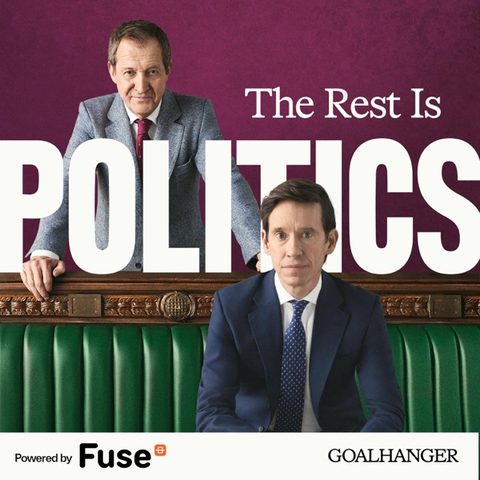
With Michael Gove sitting in for Rory Stewart, this listener Q&A with Alastair Campbell is built around the two subjects the pair have never agreed on. On Brexit, Gove defends the result as a slow-burning gain in regulatory freedom, pointing to AI, gene editing, financial services and tax changes Labour could not have made inside the EU, and to Britain outgrowing Germany since 2016. Campbell answers with a 6 to 8 percent GDP hit, falling investment and tens of millions of customs forms. Gove also takes the larger share of blame for the chaos after the 2016 vote, and both men say they expect no second referendum.
On Israel the gap is wider. Gove says he will acknowledge criticism but not start it, because Israel needs friends, and he argues the army has tried to limit civilian deaths in Gaza. Campbell counters with casualty totals and civilian-death ratios, and draws a line between the Israeli state and the Netanyahu government's conduct. Gove concedes that, as an Israeli voter, he would struggle to choose a party.
The rest of the hour covers lighter and darker ground. The two weigh the 115 Premier League charges against Manchester City and the Abu Dhabi money behind modern Manchester. Gove traces Tucker Carlson's politics back to the isolationism of 1930s America. He fields hard questions about The Spectator's coverage of Jason Arday and its interest in Enoch Powell. The episode closes with book recommendations and Gove's case for funding Gaelic.
▸About the guest
M
Michael Gove
Former Conservative cabinet minister and Vote Leave campaigner, now in the House of Lords and working at The Spectator, standing in for Rory Stewart as co-host.
▸Key takeaways
01Michael Gove stood in for Rory Stewart on The Rest Is Politics, debating Brexit, Israel and Manchester City with Alastair Campbell.
02Michael Gove says Brexit pays off through regulatory freedom in AI, gene editing and finance, after an upfront cost from new customs barriers.
03Alastair Campbell cites a 6 to 8 percent GDP hit and 39.2 million customs declarations costing UK firms about £7.5 billion a year.
04Michael Gove will not initiate criticism of Israel, while Campbell cites 81,000 Palestinians killed in Gaza, 21,000 of them children.
05Neither Gove nor Campbell expects another EU referendum, and Gove says he would vote for the status quo if one were held.
▸Questions this episode answers
Q1Does Michael Gove think the UK will hold another referendum on rejoining the EU?▾
No. On The Rest Is Politics, Michael Gove said he does not expect another EU referendum. He thinks a future Labour government is more likely to seek a mandate to rejoin through a general election, probably not the next one. If a referendum were held, he said he would vote for the status quo. Alastair Campbell replied that staying outside but closer is his own ideal position too, though he doubts Andy Burnham will be that bold.
Q2What benefits of Brexit does Michael Gove claim when debating Alastair Campbell?▾
Michael Gove argued the real economic point of Brexit was the freedom to regulate differently, with gains that build over time. He named data and AI, gene editing and selective breeding, life sciences, tech and financial services. He also cited Labour taking VAT off energy bills and adding it to private school fees, which he said the EU would not allow, and noted Britain has grown faster than Germany since 2016. He accepts the upfront hit from new customs barriers was real.
Q3Does Michael Gove accept blame for the political chaos after the 2016 Brexit vote?▾
Yes, in part. Michael Gove told Alastair Campbell that he and Boris Johnson blew themselves up right after the referendum win, and that he deserves the lion's share of blame for the leadership contest that followed. He also said Theresa May lacked a proper Brexit plan and took decisions that set the negotiations on the wrong path. He added that the Conservatives wrongly came to judge Brexit by the number of trade deals signed.
Q4Why won't Michael Gove criticise Israel over the war in Gaza?▾
Michael Gove said so many people now criticise Israel so fiercely that he is willing to acknowledge criticism but not to start it, because Israel needs friends. He argued the Israeli army tries, imperfectly, to limit civilian deaths while Hamas deliberately endangers civilians, and that Israel remains a robust democracy. Alastair Campbell pushed back with casualty figures and said his criticism is aimed at the Netanyahu government, not the Israeli state.
Q5What are the Premier League charges against Manchester City, as Alastair Campbell explains them?▾
Alastair Campbell summarised the case as 115 charges. He said Manchester City used sponsorship deals with Abu Dhabi companies, actually funded by the owners' Abu Dhabi United Group, to inflate commercial revenue by well over £800 million. Further charges cover misstated accounts and hidden pay that understated costs by almost £1 billion, while 35 charges concern failing to cooperate. Michael Gove said most non-City fans would want the club relegated, citing Rangers' demotion in Scotland as a precedent.
Q6What does Michael Gove say about Andy Burnham and Abu Dhabi money in Manchester?▾
Michael Gove said he does not blame Andy Burnham, because the UAE's role in Manchester's economy and in Manchester City's success predates his time as mayor. But he said Manchester's rise cannot be told without Emirati money, which raises hard questions now that the Premier League case suggests an unfair sporting advantage. Alastair Campbell noted that large parts of the city are owned by Abu Dhabi through the Manchester Life joint venture.
Q7What does Michael Gove think of Tucker Carlson's interview with Jacob Rees-Mogg?▾
Michael Gove agreed with Alastair Campbell that Jacob Rees-Mogg got the better of Tucker Carlson. Gove said Carlson started as a mainstream Bush-era Republican but now pushes the isolationism of 1930s America, with a tinge of admiration for fascism, in the line of Charles Lindbergh and Father Coughlin. He said low growth, identity politics and social media let people monetise conspiracy theories, on the left too, and that the right must police its own boundaries.
Q8Is The Spectator trying to rehabilitate Enoch Powell, according to Michael Gove?▾
Michael Gove said The Spectator is not trying to rehabilitate Enoch Powell, but readers are interested in political thinkers of the 1960s to 1980s and airbrushing figures from history is a mistake. The magazine ran a reflection by Powell's biographer Simon Heffer which was not uncritical. Gove said Powell was disingenuous, knowing the speech that got him sacked from the shadow cabinet would be incendiary while feigning surprise.
Our own transcript of the public episode, with a timestamp about every 90 seconds. Tap a timestamp or the link button on a paragraph to copy a link that opens this page there.
0:00We had some great questions for this episode with Michael Gove standing in for Rory, and one of my favourites was this one from Oscar. Have Michael Gove and Alastair Campbell ever agreed about anything? Well, we both think Tony Blair was an exceptional Prime Minister, and we both know that Boris Johnson was a charlatan, but we express these things in different ways. There are two big issues that we really disagree about. One is Brexit and the other is Israel-Gaza. We're going to be discussing those because we've got lots of questions on both. With Michael, unlike Rory, an actual football fan, we'll also get into Manchester City's troubles too. So plenty of scope for agreeable disagreement as we ask, will the UK get back into the EU?
0:42Will Manchester City get relegated? And will Michael Gove ever, ever criticise Israel? This episode is powered by Fuse Energy. Most energy companies are counting on you doing absolutely nothing. Not questioning what you're paying, not switching, just letting your tariff roll on, which is costing you hundreds of pounds every year. But the apathy goes deeper than our bills. We've almost given up on energy itself. We seem to all be accepting energy's expensive, the system's outdated, but that complacency is costing us. Fuse Energy does not accept that because the energy transition is not something that just happens somewhere else. Fuse is building an energy company which is designed to bring down the cost
1:26of energy and right now its tariffs are up to £100 below the Ofgem price cap. So switching isn't just about paying less, it's about expecting more from your energy company and it only takes you three minutes. Switch to Fuse at fuseenergy.com slash politics. Use the code politics and you'll get a free Trip Plus subscription allowing you to hear all the extraordinary members content that Alistair and I are now producing for you. Visit fuseenergy.com for full terms and conditions. Hi, this is Gary Lineker from Goal Hangers. The rest is football. This episode is brought to you by WISE. It's only when you start moving money between currencies that you really think about the exchange rate, the fee and what might be hidden away in the small print.
2:08Whether you're living abroad, paying someone overseas or just trying to manage your money across borders, you want a fair exchange rate, an easy transfer and no surprises along the way. Wise keeps things simple. Wise is a smart way to move the currencies you need around the globe. It works in more than 160 countries and with over 40 currencies, most transfers arrive instantly. Wise uses the mid-market exchange rate, like the one you see on Google, with no markups or hidden fees. So when money needs to move, you can see the rate, know the fee, and get on with it. Join millions saving billions on hidden fees by downloading the WISE app today. Be smart, get WISE, T's and C's apply. This episode is brought to you by NordVPN.
2:59We work out ways to protect ourselves from unwanted things every day. Okay, Rory, how do you protect yourself from small talk? I say, very good to see you. I've got to get on to get my kids from school. Yeah, you also have another one that you use quite a lot. You say, I must go. I'm on Jordan time. That's good. I'm on Jordan time. I like that. Okay, how do you protect yourself from arguing with your co-host? I just watch you argue with other people. No, I have this tactic when I think I'm losing my temper, I just rub my thumb and my index finger together, that's what I do, and I just calm down. Yeah, that's cool. And how do you protect yourself from online scams? Well, the answer is I find NordVPN useful for that. It's not just a VPN app. They've built in
3:39next-gen antivirus block scams, phishing attacks before they reach you, so you can carry on knowing you're secure. To get the best discount on your NordVPNn plan go to nordvpn.com slash rest is politics you'll get four extra months free on the two-year plan plus a 30-day money-back guarantee the link is in the episode description welcome to the rest is politics question time with me alistair campbell and me michael gove and michael gove is standing in for rory stewart and we are going to be talking about the many many questions we got on these subjects brexit middle east israel gaza and israel west bank manchester city and then we might lighten things up a bit towards the end. But let's just start with these questions on Brexit. A couple here.
4:32Simoen, do you think there will be another EU referendum? Time will tell. Tim from Birmingham. Hi, Alistair and Michael. Before the leadership challenge, Andy Burnham promised not to rerun the Brexit arguments. Now, a few months into the job, he's saying we could go all the way and rejoin. Where does he go from here? If Labour goes into 2029 offering a choice between status quo, customs union, single market, or full membership, which would each of you back? So first of all, yes or no, Michael, do you think we will have another Europe referendum at some point in our lifetime? And secondly, which of those options would you back if we did? seek a mandate, probably not necessarily at the next election, but probably at a future election,
5:25to take us back in on the basis of a general election result. So I don't think that there will be another referendum. If there were another referendum, I'd vote for the status quo. That is interesting, because that is my ideal position, the one that you've just outlined. And I've written about it in The New World this week. And I've said that I don't think even Andy Burnham will be that bold. But I hope you're right. I hope you're right. I think that'll be the right thing for the country. What do you make of his statement in his speech in Liverpool that Brexit has done more harm than good? It's very hard to dispute that, Michael. It is, I think, challenging, but I will. The interesting thing is that he acknowledged that it had done some good. So normally...
6:06So which bit of the speech did he acknowledge? It was more harm than good does not mean that good was done. Well, I took from it, and you might say that this is an example of cockeyed optimism, that he was acknowledging that there was a balance. And one of the things I'd say about the Labour government is that it has actually, in its actions, recognised that there are good things from Brexit. So taking VAT off gas and electricity bills, impossible within the European Union. Putting VAT on independent school fees. Impossible. A policy which you support, obviously. Exactly. Impossible within the European Union. No, I think you can always get right some of these taxes. You can put different taxation levels on these different things, including VAT.
6:58So, look, I think that was cockeyed optimism. When he said more harm than good, let me translate for you, Michael. He was saying it's been a bit of a disaster. And I think he's probably thinking that because of the massive, the huge hit on GDP, which whoever, I know we don't believe in experts, but we're talking between somewhere between six and 8%, according to the experts. We're talking about a big fall in investment, which is partly being blamed on Brexit. We've seen our exports fall. And you did promise, Michael, you and Boris Johnson, I know that you were a true believer and he was just a charlatan. I least respect for the fact you did believe in this. The customs declarations alone, we're now talking about 39.2 million customs declarations, individual forms,
7:48which have hit British business, we reckon, by about 7.5 billion a year. So I think it's very, very hard. And then you talk about taking rights away. We've taken rights away from people, particularly young people. So anyway, I think it's noble of you to keep pretending that there have been some advantages, but you haven't spelled them out very clearly for me. Well, I think the first thing is that the degree of the hit that the UK economy has taken is disputed. There's no such thing as an expert consensus. And also, the best comparison is not necessarily with a woulda, coulda, shoulda future, but the actual factual existence endured by our neighbours and by other countries in the EU. Alastair, we both love Germany.
8:38It's been the case since 2016 that Britain has grown faster than Germany and about at the same rate as France. No country is as embedded in the EU or its structures. No country benefits more from or is more embedded in the EU or its structures. No country benefits more from or is more restricted by the EU than Germany. So as a test case, how can it be that Brexit is such a disaster when we've been growing faster than the quintessential EU nation itself? I think, well, first thing to say is I think there is a consensus of expert opinion. It depends what you define as an expert. My definition of an expert is I do think that the big international economic institutions and the Bank of England and some of the bodies that you,
9:16I hope, would respect at least the sort of factual analyses that they do. Yes, the French and German economies have struggled. Yes, the European Union economy as a whole has struggled. And yes, I would argue that the European Union needs considerable reform as well. But I think one of the reasons why the European Union has struggled is actually because their confidence was hit by our departure. We have suffered as a result, and they have suffered as a result too. But I don't think you can dispute that GDP per capita has fallen because of our leaving the European Union. The buggeration for trade has definitely increased. And our sense of who and what we are as a country, I think, has been changed in a very,
9:58very negative direction. So I think it's undoubtedly the case that there has been some additional cost that some parts of the economy have endured as a result of leaving. But those costs have been absorbed. The benefits of being outside the EU are growing. Those benefits exist in the realm of data and AI in areas like gene editing and selective breeding. So in the growth industries of the future, life sciences, tech overall, and indeed in financial services, we've already shown that we outside the EU have the potential to attract investment, which the EU doesn't. And even this government, especially this government, has acknowledged that we don't want to be within the regulatory ambit of the EU when it comes to financial
10:50services or tech, or developing the crops and livestock that will be part of a climate transition. All of those things are easier to achieve outside the EU. And none of them are things that this government wants to give up, or indeed, that people in the banking sector or people in the tech sector want to give up as well. When I said earlier, I've always been fascinated by this, because I know it's a sort of question more for the historians. But although I was sort of teasing you and saying, do you think I'm right when I say that you were at least a true believer and probably still are? Whereas the guy alongside whom you stood at the time, Boris Johnson, actually was not a true believer and was doing this for other very different purposes, which met their goal, he became prime minister,
11:44but the damage along the way has been considerable, both to your party and to the country. I have a number of criticisms of Boris, but I actually do believe that he was a true believer. I think that, of course, he saw a political opportunity because it was likely to be the case that even if the Leave campaign lost, that a majority of Tories, Tory members, Tory voters, would emotionally be attached to the Leave campaign. And that would have been Paul's position to succeed David Cameron. I'm sure that was a factor in his mind. It may have been the decisive factor. But in his heart, Boris was definitely a leaver. Absolutely. And what about the point, we talked about Kemi Badenoch's essay, The Right Way.
12:34What about the point that she made that one of the big criticisms she had of the government that she was a part was actually that you, we had this referendum and a plan put forward by you and Johnson, etc., to leave the European Union, but there was nothing to back it up, that we left without a plan. Is that a fair criticism? I think that the more precise criticism, I think it's broadly fair, but the more precise criticism is that Boris and I blew ourselves up on the launch pad in the immediate aftermath of the referendum victory, and that Theresa May didn't really have a proper plan for Brexit. And a series of decisions were made when Theresa was Prime Minister that put us on the wrong trajectory for those negotiations
13:21and for exit. There are a number of things that Theresa did that I admire her for. I mean, I don't want to be churlish, but I think that the Brexit strategy that was pursued under Theresa was a mistake. But you talk about blowing yourselves up on the launchpad. You, Johnson, Farage delivered the victory. And then since when, we've had chaos, and we've had seven prime ministers and he hopefully will last a bit longer than most of those predecessors so you have to take some responsibility for the chaos that has followed oh i do yeah i do so point one uh vote leave did have a clear plan for uh how we could make the most of uh brexit and some of those elements of that plan were subsequently implemented. But in the
14:07week after the referendum victory, the problems during that leadership election, I think, are well advertised, and I should bear the lion's share of the blame for that. Absolutely. And then, I think more broadly, it was the case that within the Conservative Party, Brexit became associated with signing trade deals. And so the mark of Brexit success was racking up a new trade deal with where the hell is down. That was not the principal point of Brexit. The principal point of Brexit was greater regulatory freedom and autonomy. Sovereignty is the romantic element to it, which has a huge appeal to my heart, and I think is politically and ideologically important. But the economic element was the capacity to regulate differently. And this was a benefit that would accrue over time.
15:00And I believe that we are seeing those benefits. The difficulty is, and here Boris was very honest, that the down payment right at the beginning, the economic hit that you take as a result of new customs barriers is real. The economic benefits, which will accumulate over time are only there if you're savvy enough to steer the right course. And that hasn't always been the case. That's true. Okay. Well, that was moderately agreeable disagreement. We didn't shout at each other as we have done in the past. Yes. Let me just read you something very interesting from the Financial Times. This is a survey of voters around Europe, whether they would back the UK's re-entry into the European Union. By the way, I don't think we should talk about rejoin and re-entry.
15:46We should talk about joining something new and bigger that we helped to create. Let me ask you to guess which of the countries in Europe are most welcoming of the idea that we get back in and which are the least welcoming. Have a stab at that. The most welcoming I would think would be Sweden, Estonia, the Netherlands and Denmark. Well done that you got the top four right in the roll order. Well done. Yes. And least welcoming would be France, Spain, Belgium, and Greece. Ah, you did better on the welcome than the not welcome. No, you got France. The bottom four, the most unwelcoming is Bulgaria, followed by France, followed by Italy, followed by Hungary. But the figures are all, I mean, Denmark is top 75%,
16:50Bulgaria is bottom at 54%. I think that's quite interesting. I think they do feel that they have lost as much. Well, not as much, but they've lost as well. Now, we had a question. Next question, Michael. We'll definitely disagree on this one as much. Well, not as much, but they've lost as well. Now, we had a question. Next question, Michael, we'll definitely disagree on this one as well. Gordon Carrera, who presents The Rest is Classified, along with David McCloskey, he has asked us this question. How do you think the perception of October 7 as an intelligence failure on the part of Netanyahu and his government will impact the upcoming elections in Israel. And I have another question from somebody called Alistair, Alistair Campbell is his name, is have you, Michael Gove,
17:32ever, ever, ever said anything critical of Israel? So on the first, I think that there are three big issues in the Israeli election. One of them, the dominant one, is what went wrong on October 7th, to what extent was the Netanyahu government culpable for security errors both before and after. There are all sorts of conspiracy theories out there. I'm not endorsing those, but it is the case that there is a very live debate about that. Just to be clear, the main conspiracy theory being that actually he had been given some very, very credible warnings that this was going to happen and he chose not to do much about it. Exactly so. I don't give any credit to that, but I think it's perfectly legitimate as part of
18:18public debate to say, look, were we well enough prepared for any type of assault? And in the aftermath, was our response the right one? And that is the key issue. There are also subsidiary issues to do with whether or not the ultra-Orthodox should serve in the military, and there are broader economic issues as well in the elections. But on your substantive point, yes, but there are so many people lining up to criticize Israel with such vehemence and an increasing number who are increasingly vehement that I am perfectly prepared to acknowledge criticism of Israel, but I'm not really interested in initiating it. Because my view is that Israel, its cause and its population need friends at the moment. And I'm very, very proud to be one of
19:13those. But I would say that for most of my time in media and in politics, I would have said much of what you just said. But I think there has to come a point where people who support the state of Israel and support the right of Israel to exist, call out what they're doing. And when I was, I was watching a thing the other day, it was just an aerial film of Gaza before and after. It's utterly horrific what they've done. And then you look at what's happening in the west bank and you look at the way that the settlers are being encouraged and emboldened to to do things which even a few years ago would have been internationally unacceptable and then for netanyahu it seems to me to try to turn that into an electoral strategy i just think he's repellent and and i can't i just
20:04i just would love and it's not just because I want to hear them being criticized, because I actually want them to be strong and secure, just as I want the Palestinian people to be able to have a strong and secure place to look all their own. But, you know, you who are somebody who I think does, for all the joke about, you know, don't believe in experts, I think you do like to look at fact. And I find it incredible that you can't at least say they've gone completely over the top. They are killing people who should not be killed. They are treating people with a disrespect for life, a human life that I find unacceptable. Well, I don't believe that they're treating people with a disrespect for life.
20:43I do think it's the case. It's a war and innocents die in war. And you can't be indifferent to that. It's horrific for any innocent to die. But the facts, they're chilling. But the facts also point out that the Israeli Defense Force, operating in a built-up area in Gaza, have inflicted fewer civilian casualties than British or American forces inflicted operating in similar areas in a conflict like Iraq. The reality of war is horrific. But this was a war that was visited on Israel, not a war that it sought. In the West Bank, there are problems with some settlers. But again, it's not the case that they're either representative of or endorsed by anything like a majority of the Israeli population, or even a majority of those Jewish citizens who live in
21:45the West Bank. So yes, there's a problem there. But we have a problem with people misbehaving on our streets. The French have a problem with people misbehaving on their streets. The presence of some extremists within your own ranks doesn't invalid the the strength of your democracy overall just as things going wrong in a war and the commanders on the ground need to be prosecuted if they've allowed that to happen doesn't invalidate the right to defend yourself i mean i i i honestly don't see how you can make that comparison we you know we talked in the main episode about france okay you have young people protesting and in some cases rioting and you have the police putting it down what's happening in the west bank is that the security authorities are allowing something which they know
22:37to be illegal and so that to me is a virtual breakdown of law and order and also the comparisons with i don't have the figures for Iraq. Maybe I should have them on the top of my head, but I don't have them. But I do know that 81,000 Palestinians have been killed in Gaza. 81,000 and mostly civilians, including 21,000 children. You cannot possibly say that that has been justified by, and even according to their stated goals. I mean, I know the stated goals of Ben-Gabir and Smotrich are basically to say, let's wipe the lot of them out because that's what they think, and they are part of the government. But I'm just surprised, Michael, that you've, you know, even now, you've even suggested the IDF should get the Nobel Peace Prize.
23:23I'd rather Donald Trump got it than them. And I think he's utterly unqualified for it as well. Well, the first thing is that Ben Gravier and Smotrich are not representative of mainstream Israeli opinion. They are loudmouths. But they're powerful. I think the power has been overstated. They're loudmouths. They are in the government, obviously. They are ministers. But they're not steering policy. That's one of the reasons why they mouth off in the way that they do. Secondly, on the West Bank, I think there's a distinction about when people are talking about illegality. So there's obviously a continuing debate about the legality of the settlements. We won't get into that now. But is it the case that there are some, particularly younger folk associated with
24:07the settler movement, that have taken the law into their own hands? Absolutely. Is that wrong completely? Should they be dealt with? Of course. Is it the case that there are some voices in Ben-Gavir and Smotrich's parties that have a sneaking regard for them? absolutely. But Israel overall deals with people who break its laws and behave outrageously in a far more effective and proportionate way than any of its neighbours. We should hold Israel to high standards. But of course, we're speaking in the run up to an Israeli election, in which you've got fierce contestation, in which the prime minister could lose, and which if he loses, he might actually find himself for separate reasons in court. There is no other country in the Middle East in which you could have
24:58an open election, in which the prime minister could lose and then could find himself in court afterwards on corruption charges. So whatever the criticisms that people might level against the state of Israel and how it's conducted itself in this conflict, it remains a robust democracy, one in which the balance of power in this election after votes have been cast may be held by Arab parties. There's no Jewish party that holds the balance of power in in in other countries and then on the toughest point of all about those civilian casualties the key thing here is that hamas and we both know that hamas does not represent the majority of palestinian people but still hamas deliberately puts civilian lives at risk, while the IDF imperfectly, but consistently,
25:48tries to minimize civilian casualties. And that's the key difference between them. And that as long as that prevails, then you will find me absolutely on Israel's side. Okay, just their own figures, the Israelis the israeli's own figures their military data indicates a civilian death rate in gaza of 83 percent they previously claimed it was 50 percent they're now acknowledging 83 percent uh civilian rate of civilian casualties in american wars in iraq and afghanistan 68 and 26 respectively now too high of them too high, but I think we are dealing with something different. And also, by the way, Michael, I'm not criticizing the state of Israel. I'm criticizing the conduct of this government in relation to the way that it has responded to
26:36October 7th. And I would always say when we talk about this, that what Hamas did was unspeakable, unforgivable, and there are some very, very bad people with a very, very bad ideology. But I think the response has been disproportionate. And I think it's one of the reasons why Israel now has so many critics around the world and has lost so many friends. So the first thing is, I've never doubted that you and Rory are good faith actors in this debate. And everything that you've said that's critical of Netanyahu has also been articulated by people within Israel, Israeli journalists, politicians, and activists. So your position sits squarely within Israeli domestic political debate. So I don't doubt both the
27:19sincerity and the force of your case. And there are other people whom I like and admire who share it. I just disagree. The second thing is that the figures on casualties and the basis of the calculation was gone into by a House of Lords report that was produced for the APPG there. Maybe, up to you, we could include a link to that and to your data for listeners in the newsletter that you send out. They can compare and contrast and draw their own conclusions because it's such an important issue. But the final thing that I would say is that if I were living in Israel now, I would find it difficult to know who to vote for. Because while I am supportive of the state of Israel in its actions to defend itself,
28:14I do think that there are all sorts of criticisms that can be directed at Netanyahu and the choices that he's made, and that there are other leaders and other parties that might give Israel a better future. But as I say, my general disposition at a time when, and it's so important that I draw distinction between the points that you and others make critical of Israel and what I'm about to say, but when you've got folk like the Green Party leadership taking the position that they do, in the broad scales, I'm very happy to be on Israel's side. That doesn't mean that I want to undermine or delegitimize criticism of it, but it does mean that in that broader debate, I know where my heart and my head are. Okay. Well, let's take a break.
29:01And then when we come back, we'll talk about Manchester City and the continuing controversy surrounding the way that they've been funding themselves. See you soon. is it still holding on to that embarrassing moment from years ago? That tough breakup? The conversation with your boss you keep rehearsing in the shower? If you could permanently delete one thing from your brain, what would it be? BetterHelp is an online therapy platform that gives you space to talk about what's taking up too much of yours. BetterHelp is now in network with more than 125 health plans, with many co-pays as low as $15 for eligible members. And if you don't have eligible insurance or live outside the U.S., you can still get 10% off your first month. Sign up and get 10% off at betterhelp.com
29:50slash restpolitics. Cost and coverage may vary. Ulcerative colitis and Crohn's disease symptoms don't pause for the moments that matter. That's why understanding your treatment options matters. Discover what's possible with Trimfiya. Guselcamab. Trimfiya is a prescription medicine used to treat adults with moderately to severely active Crohn's disease and adults with moderately to severely active ulcerative colitis. Serious allergic reactions, increased risk of infections, or lower ability to fight them in liver problems may occur. Before treatment, get checked for infections and tuberculosis. Tell your doctor if you have an infection, flu-like symptoms, or need a vaccine. Talk to your doctor and explore what's possible.
30:30Or call 1-800-526-7736 to learn more about Trampaya. And visit TrampayaRadio.com. Are you looking for support in your weight management journey? Zepbound Terzepatide may be able to help. Zepbound is a prescription medicine used with a reduced calorie diet and increased physical activity to help adults with obesity or some adults with overweight who also have weight related medical problems to lose excess body weight and keep the weight off. Zepbound is approved as a 2.5, 5, 7.5, 10, 12.5, or 15 milligram injection. Zepbound contains terzepatide and should not be used with other terzepatide-containing products or any GLP-1 receptor agonist medicines. It is not known if Zepbound is safe and effective for use in children.
31:18Don't share needles or pens or reuse needles. Don't take if allergic to it or if you or someone in your family had medullary thyroid cancer, or if you've had multiple endocrine neoplasia syndrome type 2. Tell your doctor if you get a lump or swelling in your neck. Stop, zip bound, and call your doctor if you have severe stomach pain or a serious allergic reaction. Severe side effects may include inflamed pancreas or gallbladder problems. Tell your doctor if you experience vision changes before scheduled procedures with anesthesia. If you're nursing, pregnant, plan to be, or taking birth control Thank you. Talk to your doctor. Call 1-800-545-5979 or visit zepbounce.lily.com. Welcome back to the Rest is Politics question time with me, Michael Gove.
32:20And me, Alistair Campbell. And Justine from Manchester is one of many people who has asked us about Manchester City. Justine's question goes as follows. Andy Burnham's Man City comments were treated as a gaffe, but weren't they just an honest account of how modern Manchester was built? Courting Abu Dhabi money and big foreign investment is a core part of Manchesterism. If that model depends on not asking awkward questions about where the money comes from, what does that mean for Burnham's vision for the country? I guess that gets to the heart of whether there is now a political and a diplomatic angle to this as well as just the sporting angle. I think there is. So I don't blame Andy Burnham.
33:01The role of the UAE in Manchester's economic success and in Man City's footballing success predates him becoming the mayor of Greater Manchester. But it is the case that you can't tell the story of Manchester's success without the Emirati element within it. And it does raise some difficult questions, not so much for Andy Burnham, but more broadly about how Manchester grew over the course of the last decade, decade and a half. I do think it's wrong to welcome a golf investment. In particular, I think of all of the golf states, the UAE is one of the most admirable in relative terms. However, for football fans overall, it's clearly the case that the Premier League have found that the relationship between state financing and the rules of the game have led to Man City securing an unfair advantage overall. And because of that, it will raise profound
34:07questions about the role of the Emiratis in funding Manchester's success. But I don't think anyone's found, even though the rules of the premiership may have been broken, I don't think anyone's found anything else to suggest that Emirati investment has somehow been, you know, so far as we know, dodgy in Manchester itself. I mean, partly because Rory has a bit of a blind spot about football. We're all allowed our blind spots. I have blind spots, too. This is the first time we've actually talked about the Manchester City situation on the podcast. So maybe just briefly, if I go through what this report said and what the main accusations were essentially the first issue is one of sham contracts and disguising the
34:53funding that's going to the club so they use this disguised funding scheme essentially to inflate artificially inflate their commercial revenues by well over 800 million pound fake sponsorship contracts with companies that were based in Abu Dhabi, where the money was actually being paid by the Abu Dhabi United Group. And this violates the rules against direct owner equity injection. Okay. The next thing was concealing the true financial state, misstated accounts, misleading aud auditors artificially inflating revenues and lowering true operating expenses by almost a billion hidden compensation and salary schemes and then 35 of the 115 charges were about non-cooperation and failure to be open and honest so serious serious stuff and of course
35:40massive consequences because i mean my team as you, is Burnley and we were involved in a dispute with Everton. We got relegated and Everton had broken rules way, way less serious than this. Yes. argument was we might not have got relegated if Everton who came just outside the relegation zone etc so every club in the Premier League could argue that they have lost money as a result of this the questions now do Manchester City get relegated do they get kicked out of the league do they get told they can't buy any new players for 10 years I don't know if you know this, Michael, Manchester City are currently 5-1 to win the Premier League and 13-8 to get relegated from the Premier League, which is a pretty extraordinary thing.
36:34And so this is a huge story that's going to run and run, particularly now as they've appealed. And the appeal could last the entirety of the season. So they might end up winning the Premier League with virtually every other club thinking, well, you didn't deserve to win the ones that you've won, let alone this one. You're absolutely right. There's a sort of double jeopardy here in that it's not just Manchester City's sporting achievements that have been tarnished. There's hard cash as well because the position in which you finish in the Premier League and indeed whether or not you stay in the Premier League determines how much cash you get in the next season and we're talking gazillions here because of the success of the premier league and and and again this is part
37:15of it that money invested in uh teams like manchester city have uh attracted international talent they've led to the regeneration of parts of Manchester. And it's also the case that there are other clubs like Newcastle that have benefited from Saudi investment. So it's undeniable the case that the success of the Premier League has been a honeypot. But because of that, those who are perceived or in Manchester City's case, accused of having garnered an unfair advantage are not just getting extra silverware, they're getting extra dollars to a remarkable extent. So it becomes a very intense competition with lawyers inevitably being engaged by the other teams. And also there's a parable here as well. In the Scottish Premiership, as you know,
38:06Scottish football for a long time is essentially a geopoly between Rangers and Celtic. But Rangers were guilty of some very dodgy financial dealings. And they were chucked down a couple of leagues. Exactly. They were thrown out of the Scottish Premier League, put into the bottom league, essentially, in Scottish football. They fought their way back up, but it was a lesson to them and indeed to Scottish football overall that be ever so mighty, if you break the fundamental rules of the game, then there will be retribution. And I suspect that almost everyone who is not a Manchester City fan would say that whether or not they should be stripped of past titles, they should certainly be relegated at the end of this season.
38:52Well, and because they're such a top club, nobody's ever thought they'd get relegated. It means that players like Erling Haaland, I don't think Erling Haaland has a relegation escape clause in his contract. There's a very funny um ai thing i shouldn't laugh at ai because i think it's a menace to the world but of erling harland channeling david brent as he lists all these extraordinary places that he might be happy to go to play football in bracken or maidenhead etc yes i'm going to say i'm i i find that one different part of this i find very difficult is that howard bernstein who died not long ago, and Richard Leese, who are both, we've talked about them many times on the podcast, they're absolute giants in local government.
39:33And I do sort of pause for thought when I hear Richard Leese say, the Sunday Times, who's been reporting on this issue for years. And a lot of what limited knowledge I have comes from reading his stuff. And what I hadn't fully understood was the extent to which large parts of Manchester are now actually owned by Abu Dhabi. Yeah. And that this joint venture that they had called Manchester Life. And they did get decent deals on the land, 990-year leases. And Richard would argue that the land was derelict brownfield site, nobody else had the money to develop. And this was a way to get growth going. And indeed, growth was going. But of course, now that Andy is the Prime Minister, I think you're
40:22being very fair in saying that this happened, as it were, not directly on his watch. But it was interesting that he got criticised for coming out and saying, I hope that Abu Dhabi doesn't get pushed out of Manchester, because people at the time were just seeing this as a football issue. And if Manchester City cheated, as you say, they should be punished. But obviously, what Andy Burnham knows is the deeper economic link between Manchester and Abu Dhabi. The success of Manchester has been built to a significant extent on its capacity to attract investment from abroad. And you're quite right, Richard Leeson and Howard Bernstein, who led Manchester, did a very, very good job in that regard. That achievement now looks like being tarnished, but it's made a real beneficial difference to the citizens of Manchester.
41:10Yeah. Now, a question here from Gary in Swindon. First of all, before I ask it, Michael, have you seen any clips or the whole thing in the interview between Tucker Carlson and your friend Jacob Rees-Mogg? I have seen clips. I haven't seen the whole thing. Okay. And the question is this. 20 years ago, somebody expressing views like Carlson's would have been laughed out of mainstream political discourse as a heretic. How does someone go from being a mainstream broadcaster to promoting conspiracy theories, historical revisionism, and obvious misinformation while retaining an enormous audience that apparently trusts him? Now, I have to say, I watched a fair chunk of it. I find Tucker Carlson pretty repulsive.
41:50I did have a bit of a run in myself with Jacob Rees-Mogg recently when we did a 10th anniversary event with Michel Hussain at Bloomberg about Brexit. And he really went on the attack, which said to me, Michael, he wasn't feeling very confident about his arguments. But there we are. But my sense is that Jacob Rees-Mogg got the better of Tucker Carlson by some considerable distance. I think that's completely correct. One of the interesting things about Tucker Carlson is that he started out as a sort of relatively mainstream Republican figure. You know, he was the supporter of George W. Bush. And his whole demeanor is very preppy American establishment. And when you see him, you assume that he would be,
42:32you know, one of those sort of, you know, East Coast, George Bush, Republican figures. But what he's peddling, what he's increasingly peddling, is the sort of republicanism that America had in the 1930s, and which we thought that the Second World War had extinguished. So it's not just isolationist. It's isolationist with a tinge of admiration for fascism. And when you had that with Charles Lindbergh before the Second World War, and also there was a very famous radio broadcaster in the 1930s in America called Father Coughlin, who was a part of that trad cath antisemitic tradition. The feeling was that that was extinguished by the experience of the Second World War and the experience of the Cold War.
43:20But antisemitism is a light sleeper. Tucker Carlson has started trafficking in that. But more than that, he's linked it to a variety of other conspiracy theories. And one of the trends of our time, which is worrying, which you've lighted on, Alistair, is the way in which a toxic mix of low economic growth, increasing identity politics, rampant social media has created scope for people to monetize conspiracy theories and prejudices. Now, I'd argue that there are people on the left as well, like Hassan Paika in America, who are operating in the opposite pool. So I don't think it's just a problem on the right. But it's undeniably the case that Tucker Carlson and also this guy called Nick Fuentes,
44:07who's, if you can imagine such a thing, even worse, are reviving demons. They are raising dark forces from America's buried soul. And the same thing is happening in the UK as well. Well, not least, I least with, I would argue, with GB News. What? Of which Jacob Rees-Mogg is a prominent player. So, but I did think, I must say, I thought he, I mean, I thought he really came back at Tucker Carlson. I mean, Carlson was saying the most ridiculous things. Yes. Including some factually stupid things like the Russian economy is bigger than the UK economy. But when he got on to, you know, what was the point of Britain getting involved in the war in the second world war it was kind of you could see that even Jacob was thinking oh quite wonder
44:54if I should agree to this conversation yeah so there's a legitimate scholarly debate with some people who revisionist historians who question whether or not every aspect of Britain's policy in the 1930s and 1940s was right. That's fair enough. But when you get into the Carlson territory, it's beyond that. It's a sneaking regard for Hitler. It's David Irving type territory. But the one thing I have to do, and I have to say this, I think both out of defense of Jacob and more broadly, is that GB News, and I know that you don't like most of the content, I can understand why, does draw a line. And there are people who have crossed that line who've been thrown off GB News. The difference with Tucker Carlson is he hasn't just crossed that line, he's trampled over that line with glee. And I think that this is
45:45something which is, it's as much an issue for me and people like me as it is for anyone else, which is, if you are on the right, how do you ensure that in your commitment to free speech, that you welcome challenge, but you also police a boundary so that when people are trafficking in conspiracism, or when they are recycling prejudice, that you say, okay, we know what you are, you are no longer welcome on our platform, or in our broad team. You know, I'm very anti censorshipcensorship, but I also think that there's a responsibility to say that if your title or your studio carries with it any sort of prestige or status or reach that you should say, no, you're out if people cross certain lines. Okay. Well, listen, that leads me onto a couple
46:40of questions. We had a lot of questions that were about you, Michael, and the spectator. Oh, yeah. James asks whether michael feels any responsibility along with the rest of the right wing media for jason arday's death and ed asks why is the spectator trying to rehabilitate enoch powell very good questions tough questions for you again um we still don't know all the circumstances surrounding j Jason Arday's death. But I think it's absolutely legitimate to have a debate about whether or not this was a story that was blown out of all proportion, because that has ramifications for how people in universities and more broadly see themselves. I don't think that the media should feel responsibility for Jason Arday's death. I think, and here I am
47:27making a tentative judgment, that for Jason Arday, it wasn't so much the media coverage from the right-wing press, it was more the sense that within those people who'd hitherto been supportive of him, that there was a withdrawal of support that may have contributed to a sense that friends and allies and those upon whom he had relied were less constant. That may have contributed to some of his feelings. What about maybe the lesser accusation, which I think I would make, that the story took on a tone and a volume that was utterly disproportionate and that only happened that way because people on the right want to say that if a black person gets on it's because they're black and it's the whole DEI debate that we've seen become so toxic in the United States and that
48:21the left I would agree with you parts of the left-wing media got way way way, way caught up in that, whereas actually, I think they should have been challenging the response more than just sort of diving into it themselves. I think it's fair to ask tough questions and compel people to examine what the impact of their coverage might be on wider society. Within that, I would say two things. There are other people of colour in education, Catherine Burble-Singh, who've also been attacked on the other side because of their views. So someone like Catherine has been very vigorously attacked by people on the political left, sometimes in terms that I would consider to be beyond unchivalrous. So there are risks. I think you are right in being out there in a debate at
49:07the moment where identity politics overall has become a stronger force in our conversation. But I also think that quite a lot of the R. Day criticism wasn't directed at R. Day himself. It was directed at Cambridge. And in particular, the worst questioning of the quality of his work and the reason why Cambridge were vaunting and giving luster to his work when it was, and it seems so graceless of me to mention this when the poor guy is dead, but when his work wasn't necessarily of the standard you'd expect of someone who was a professor in the Department of Education. But when we discussed this, Rory and I discussed at the time, we had a long list of people of whom the same and worse could be said, of whom there was no media furore whatsoever. And the other
50:00thing, you mentioned Catherine Birbelsingh, who actually gets a shout out in Kemi Vadenock's essay that we talked about, because she is one of those people who has a lot of media and political protectors on the right. This guy had no media and political protectors anywhere. I compare and contrast the coverage of him with the coverage, say, of James Orr, another Cambridge University associate professor, who was exposed in that film about Farage and funding as an absolute charlatan, sort of in plain sight to my mind, political corruption. And yet, does anybody who's listening or watching this really know who I'm even talking about? Because it got next to no coverage. They all know about Jason
50:50Arday, and they knew about it before his death. Well, the thing about Jason Arday is that you're right that towards the end, some of those who had been his supporters and champions were silent. But he did have, right until the moment of his death, being reported some very articulate and prominent political and media champions. And he had been a significant media presence. He'd guest edited the Today programme on Radio 4. He'd been awarded a book contract by a reputable publisher. Indeed, his memoirs are still available out there. And, you know, his aspects of his story are undeniably affecting. So I don't think it was the case that Jason Arday was a lone figure who for much of his career was unsupported by a media or political sort of scaffolding. That was all there. It
51:38crumbled towards the end. More broadly, I think it's the case that James Orr's future has been placed in the spotlight, both by Cambridge University and by others, including his own party, Reform, as a result of the allegations that have been made against him. And I think that we'll have to wait to see how that plays out. But I think that, to go back to the original question, the spectatorsators coverage and the coverage of other newspapers of the affair was driven to an extent by concern about what was happening in our higher education institutions and one of the pieces that that I wrote under my name which is linked to the RD affair was less about Jason Ardy and more about the person Hilary Kremen who's the professor who's in charge of the education department.
52:27My criticisms of her were not personal. They were about what's going on in her name, within her department, when it comes to the training of the next generation of teachers. And I'm very happy to stand by that critique. And indeed, if Hilary Kremen wants to write for The Spectator or appear on our baby podcast, Quite Right, then brilliant. Maybe we could interview her on Leading Together if Rory's on holiday again in the future. You can't keep taking holidays like this, Michael. We have to get a grip of this conservative work ethic. And what about the rehabilitation of Enoch Powell? Is that a good thing? So I don't think that we're actively seeking to rehabilitate Enoch Powell, but I think it is the case that people are interested in the influence of political thinkers from the 60s, 70s and 80s.
53:15And two things. One, my friend and rival, Tom McTague, who's the editor of The New Statesman, wrote a very, very good book about Britain's relationship with Europe called Between the Waves. And in it, he takes Powell very seriously. And he's unsparing in his criticism of what he sees as Powell's opportunism and nativism. But he's also very interested in Powell's ideas. What we did at The Spectator was run a piece by Simon Heffer, whose original biography of Powell, like The Roman, was published more than a decade ago. It's been reprinted, and Simon reflected on Powell's legacy. It wasn't an uncritical reflection, though on the whole, Simon thinks that Powell was more sinned against than sinning.
54:05And I think that trying to airbrush figures from history is a mistake. And as time passes, we can have a genuinely rounded view of their legacy. That doesn't necessarily mean, and it mustn't mean, being negligent about their errors. And to be fair, overall, Simon does make the point that there was, even though Powell presented himself as a fearless truth teller, there were disingenuous elements to his character. And the speech that got him fired from the shadow cabinet was one which he knew was going to be incendiary, even though at the time he pretended to some of those around him that he was surprised by the vehemence of the reaction. So yes, Powell was disingenuous, and he did pretend to being above base calculations in politics
54:57and a fearless truth-teller when, in fact, he was thinking about how he could position himself for a future leadership challenge. We've seen all that before. And I think it's one of the things that both of us recognize, that all politicians are a mix. So there is no politician who is without ego or vanity. And in the same way, almost all politicians, there may be exceptions to this, even the most Machiavellian, at least have some element of a desire to improve the public realm somewhere in their character. Okay. Well, listen, we've covered a lot of ground, Michael, both in the main episode and now in the Q&A. Thank you for standing in for Rory. We do like to give our readers of the newsletter a few book recommendations.
55:47You've just given one, Simon Evers. What are you reading at the moment? What do you take to Birmingham with you? Well, one thing that I do recommend is Johnny Mercer's memoirs. Oh, I read it. It's terrific. I just read them over the weekend, and Johnny was a colleague. He's very honest about the challenges he faced. And as you read it, you recognise he's got a formidable sense of humour. He's a man of principle. He can be an infuriating colleague, but he's also someone who politics was stronger for. So I've enjoyed that. And then also I've just started a new history by a guy called Douglas Smith, who's written about Rasputin and the Russians in the past. He's written a book about Vienna, called A City Without Jews, which is about what happens with the Nazi takeover of Austria. And it's based around the experience of one particular family. And it's the best sort
56:47of history, because it combines both a big and timely theme with close personal detail about the experience of individuals with whom you can identify. Excellent. Good. Well, I've just finished because we've got him, I don't think he's out yet in the UK, but we've got Michael Lewis coming on the podcast quite soon. And he's written this extraordinary book about Doge and in particular focusing on the people who tried and in the most cases failed to stand up to Doge. And I'm now halfway through this absolutely beautiful book by somebody called Sophia Smith-Gaylor, who is actually a Goldhanger mentee. And it's called How to Kill a language and it's absolutely beautiful um it's really about the the the loss of languages that we're
57:34facing around the world and the she's got this word linguicide oh yes uh so it's a wonderful are you a gaelic speaker at all i'm not a gaelic speaker, but I did in the House of Lords the other day join forces with Catherine MacLeod, the Labour Baroness, in order to put pressure on the government to properly fund Gaelic. And when I was in government, we set up something called the Islands Forum, which was explicitly there to support the island communities in Scotland and also in Wales. And part of that was making sure that we could have funding for the Gaelic College in Lewes, which teaches in the Gaelic language, Gaelic medium. And I'm a very strong supporter of Gaelic, of Welsh, of indigenous languages, because I think that they are, they're just as much part
58:25of our culture as soaring cathedrals or Purcell. And we've got to do everything we can to keep them alive. And some of the finest poetry of the 20th century was written in Gaelic. Absolutely. Well, that's very good, Michael, that you were using your time in the House of Lords for good. For once. Unlike when you were playing such a central role in putting an end to the assisted dying bill. But it's my podcast. I will have the final word. You're not coming back on that one. Thank you very, very much for both episodes. I've thoroughly enjoyed both of them. Thanks very much, Alistair. See you soon. It's getting chilly outside. But you know what that means? It's time to cozy up with Panera Bread.
59:20Let's get toasty. Cheesy. Oh, hello, broccoli cheddar soup in a bread bowl. How about melty? Okay, Chipotle chicken avo melt. It's dipping bread and soupy goodness season. Oh yeah, we are so back. It's Panera season. Order now. John Ray, your friend and jeweler at Shane Company. When you buy an engagement ring or fine jewelry gift from Shane Company, you get more than what you paid for. Our jewelry comes with our all-inclusive free lifetime warranty. It covers everything. There's no fine print. You'll get unlimited cleanings, resizings, and repairs. Plus, it even protects your engagement ring's center stone. We stand behind the quality of our jewelry, and that's our gift to you this holiday.
1:00:03Peace of mind. Because a friend knows the best things in life are free. Shane Company, your friend and jeweler. I'm Hannah. I've lost 75 pounds in 20 months with GLP-1s, plus diet and exercise. On Rowe, I've gone from struggling to run a mile to running farther every day. You can access FDA-approved GLP-1s online. Get the support you need to reach your weight loss goals. Go to Rowe.co slash weight to see if you qualify. I'm a paid row partner. 20% average weight loss in one year and non-diabetics with obesity or overweight with a weight-related medical condition versus 3.1% in placebo arm. Rx only. To stay informed about serious side effects, go to row.co slash safety.