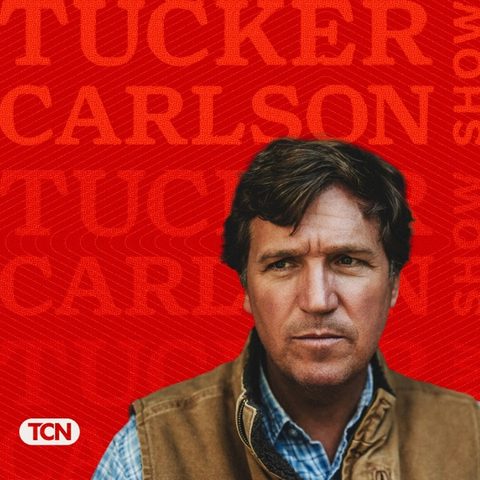
“we have misunderstood the idea of progress.”
Tom Frank · at 41:26 — ▶ hear it from here
“say what you will about the Luddites. They knew that they were about to be destroyed and they tried to fight back.”
Tom Frank · at 1:19:05 — ▶ hear it from here
▸What this episode covers
Tucker Carlson hosts author Tom Frank, whose new book argues that creativity and innovation have been turned into words that justify elite power. Frank says creativity was once a human virtue, but it now labels the professional class and makes tax cuts, tech subsidies and special favors for certain cities seem deserved. He traces the word's rise after World War II, when self-help books, psychology studies and corporate research labs made it a national priority, and when Sputnik turned it into a Cold War answer.
Frank argues the policy results have been poor. He points to the 1978 capital gains tax cut, sold by supply-side Republicans as a route to innovation, which drew money into venture capital without making Americans more inventive. He says productivity growth has fallen to roughly half its 1950s and 1960s pace, that offshoring was defended by claiming design work stayed at home while making things was not creative, and that bailouts flowed to industries branded innovative while ordinary firms and workers were left to fail.
The conversation then turns to universities and technology. Frank describes adjunct instructors who are paid little for a full course load, growing ranks of administrators, and tuition that now runs far beyond what in-state students paid in the 1960s, partly because of the 1980 Bayh-Dole Act. Both men end on artificial intelligence, which Frank sees as the newest version of the same pitch, and Frank says he strongly supports the Luddites for fighting back against the machines that would destroy their work.
Have a recording of your own? Paste a link or upload it.
WhipScribe sends back a timestamped transcript, like the one on this page.
Every recording starts with a free preview. Full transcripts come in packs from $4 for 300 minutes. Uploads up to 10 hours or 5 GB.
▸Tom Frank on Tucker Carlson Show: the answers
Who is Tom Frank?
Tom Frank
Tom Frank is a writer and historian with a PhD in history who has long written about labor and the middle class. He is on the show to discuss his new book on how creativity and innovation became words used to justify elite rule.
What did Tom Frank say about Barack Obama?
Tom Frank says Barack Obama made innovation a central theme of his presidency, rolling out an innovation agenda at a Google headquarters event while campaigning against Hillary Clinton. Frank argues that Obama's answer to the decline of Midwestern towns was more STEM degrees and innovation, which he calls an evasion rather than a solution.
“He did an event at Google headquarters where he rolled out what he called his innovation agenda.”Tom Frank · 29:25
What did Tom Frank say about Ronald Reagan?
Tom Frank says Ronald Reagan was an early and enthusiastic user of the word creativity, which he compiled into a 1960s book of speeches titled The Creative Society. Frank links Reagan's rhetoric to the later tax cuts that were sold as ways to spur creativity and innovation.
“Ronald Reagan loved the word creativity.”Tom Frank · 15:17
What did Tom Frank say about Post-industrial society?
Tom Frank says the post-industrial society idea, developed in the late 1960s by thinkers including Daniel Bell, Peter Drucker and Zbigniew Brzezinski, treats manufacturing as the past. He says it was used to justify offshoring and tax favors for a creative class, and that its results have been a disaster.
“we have misunderstood the idea of progress.”Tom Frank · 41:26
What did Tom Frank say about Silicon Valley?
Tom Frank says Silicon Valley gave about 70 to 1 in donations to Hillary Clinton over Donald Trump in 2016, then completely flipped sides by 2024. He describes Trump as Silicon Valley's man at this point, and says the Obama White House was filled with former Google employees.
“Silicon Valley supported Hillary by 70, in terms of donations, 70 to one over Trump in 16.”Tom Frank · 1:19:05
What did Tom Frank say about Luddites?
Tom Frank says he strongly supports the Luddites, the 19th-century workers who fought machines that threatened their livelihoods. He argues they knew they were about to be destroyed and tried to fight back, and says people should do the same in response to AI.
“say what you will about the Luddites. They knew that they were about to be destroyed and they tried to fight back.”Tom Frank · 1:19:05
What is Tom Frank's main argument on The Tucker Carlson Show?
Tom Frank argues that creativity and innovation have been turned into words that justify elite rule, from capital gains tax cuts and offshoring manufacturing to bailouts and the rise of AI. He says the post-war push to celebrate creativity coincided with falling productivity, weaker universities and a hollowed-out middle class.
Mentioned in this episode
PersonRonald Reagan
PersonBarack Obama
PersonZbigniew Brzezinski
PersonPeter Drucker
PersonGeorge Gilder
PersonSam Altman
PersonDonald Trump
EventSputnik
OtherBayh-Dole Act
CompanySilicon Valley Bank
CompanyGoogle
Episode facts
Released
November 13, 2026
Length
1 hour 22 minutes
▸Key takeaways
01Tom Frank argues that 'creativity' and 'innovation' became words used to justify elite privilege, from tax cuts to bailouts to public favors.
02Ronald Reagan's 1978 capital gains tax cut was sold as a way to spur innovation, and it sent money to venture capital instead of making more things.
03Frank says U.S. productivity growth has fallen to about half its 1950s and 1960s pace, despite a decades-long push to celebrate creativity and innovation.
04The 1980 Bayh-Dole Act let universities patent federally funded research, and Frank says it helped turn campuses into profit-minded institutions.
05Frank says the Luddites were right to fight automation, and calls Silicon Valley's AI push the newest creativity pitch to justify elite power.
▸Questions this episode answers
Q1What did Tom Frank say about creativity being hijacked by elites?▾
Tom Frank told Tucker Carlson that he is not against creativity, but against how the word has been used to describe the American elite as creative and innovative, and so to justify cutting their taxes and giving them public favors. He says the term became a way of rationalizing rule by a professional class, and that the self-help and psychology boom after World War II helped make creativity a supposedly learnable trait.
Q2What does Tom Frank say about Ronald Reagan and the 1978 capital gains tax cut?▾
Tom Frank says Ronald Reagan loved the word creativity and compiled a book of speeches in the late 1960s titled The Creative Society. Frank says the 1978 capital gains tax cut was sold as a way to spur creativity and innovation. He says it did draw money into venture capital and made the stock market more attractive, but did not make Americans more innovative.
Q3Why does Tom Frank say offshoring manufacturing was justified as creative work?▾
Tom Frank says he heard a businessman on NPR defend Trump-era tariffs by saying the firm would keep the creative work in America and do only manufacturing in China. Frank says that is the theory these figures believe, that design is creative and making things is not. He calls the claim false and insane, and says shop-floor workers constantly innovate.
Q4How does Tom Frank explain the Bayh-Dole Act and rising university tuition?▾
Tom Frank says the 1980 Bayh-Dole Act, passed by Senators Birch Bayh and Bob Dole, made it easier for universities to patent scientific research, mainly pharmaceuticals. He says this became a bonanza for universities, which hired lobbyists and built innovation centers, and turned them into more mercenary institutions. Carlson and Frank discuss tuition of roughly $80,000 to $90,000 a year, compared with free in-state tuition at the University of California in the 1960s.
Q5What does Tom Frank say about adjunct professors and university administrators?▾
Tom Frank says most university teaching is now done by adjunct instructors with no job security. He says he once earned about $1,500 for a whole semester, and that many adjuncts live in their cars. He also says administrators have multiplied, and that a Stanford professor told him the ratio of administrators to undergraduates there had reached one to one.
Q6What did Tom Frank say about the Luddites and AI on The Tucker Carlson Show?▾
Tom Frank said he supports the Luddites strongly and does not look down on them, because they knew they were about to be destroyed and tried to fight back. He says AI output is terrible when it imitates his writing style, which he compares to social realist propaganda from the 1930s. He also says AI cannot help with novel historical research because it is an amalgamation of other people's opinions.
▸Transcript
Our own transcript of the public episode, with a timestamp about every 90 seconds. Tap a timestamp to play the episode from there in the show's own player; the link button on a paragraph copies a link that opens this page there.
0:00Tom Frank, thank you for doing this. Tucker Carlson, great to be here. So you've got decades of experience writing books that made people mad. Made them happy, made them laugh. Exactly. But now you've written a book against creativity. How could you be against creativity? Good question. So I'm not actually against creativity. I'm against the way the word has been like basically hijacked and used to excuse. Well, I'll do the whole thing real quick here, plutocracy. So this word, which is a magical word, a word that describes what is most human and most valuable about us, has been taken over the years and used to describe, well, the American elite. You know, they are creative. They are innovative. Why do they succeed? Because they are innovators.
0:54You know, why should we admire them? Because they are creative. Why should we cut their taxes? Because that's how to get innovation going again, et cetera, et cetera, et cetera. And it's become a kind of a word for rationalizing rule by an elite. What is creativity? Well, look, it's supposed to be, the definition of it that people use is it's a kind of mental faculty that is analogous to IQ, but with two important differences. Everybody can participate. IQ is supposed to be born in, it's genetic, and it doesn't change in the course of your lifetime. The main idea behind creativity is that everybody can do it and you can learn how to do it. So your creativity can change. You can get better at it as you go through life. Now, none of this is
1:44particularly scientific and it all sort of, it all pretty much falls apart under scrutiny. But nevertheless, there's a reason that we admire artists and we admire novelists and we admire musicians and we admire people that create. You know, this is- Make new things. It's the spark of the divine in the human being. Exactly. God created, we are made in his image, therefore we create. Exactly. It is the most beautiful and human thing, I think. Or among them, anyway. Yes. So- Yes, the word. The problem is the way the word has been completely and utterly hijacked. And in some ways it's – I'm sorry. I got ahead of you there. Should I – No, no, not at all. It's perfect for this kind of linguistic hijacking that I'm talking about because it's something that we all love.
2:37It's something that there can be nothing wrong with it. And the same with the word innovation. You know how you see it? You see it everywhere. I saw it on a bus on my way up here. You know, it's like a bus line called innovative. And it's this word is everywhere. And the reason that it's everywhere is because we admire it so much. There can be nothing wrong with this. This is this is the noblest of human faculties. This is what makes our country prosperous. You know, this is supposedly what makes us unique among the nations is that we're a creative people. We're an innovative people. And this is why our economy is, you know, is, or this is why we're such, you know, so affluent. I did notice a change. I didn't, I mean, I noticed it. I didn't understand it as it was
3:19happening, but the creativity, obviously undisputed good. But the creative class... There you go. Right, is a different thing. So the creative class was always viewed by suspicion, in my perception, by the ruling class. The creative class was this kind of separate, distinct thing. But Tucker, what if you redefine the creative class and you say they are the ruling class, or you say the ruling class are creative? How about that? Well, but this is the correct designation for the dominant class in America. But he's using it to describe all sorts of people, not just artists, not just writers, but basically every manner of white-collar professional, highly educated professionals are quote-unquote creative,
4:21and they're this dominant elite. But because they're creative, we're supposed to look up to them, respect them, admire them, and do these massive public favors for them. And this was the upshot of that book and that theory. And by the way, it's still going. There's cities all over America that, constantly doing this, building special tax districts for creatives and special, you know, supporting all kinds, well, you just think of all the things they did, building bike paths, you know, encouraging coffee shops, you know, doing all this stuff to lure, to bring creatives to your city. Because once you did that, then you would have prosperity. Well, then wouldn't the arts flourish? But the arts have withered. The arts have, yes.
5:07In fact, they're basically gone. Yeah. I mean, it's, so the irony that hangs over this book is that while at the very same time that we have worshipped at the shrine of creativity and also of innovation, that those things have been dying in this country. And we never talk about it, right? I've noticed. But we all know this is true. I'm a writer. I know a lot of writers. It is the worst time that I can think of to be a writer in America. You know, prices go up and up and up all the time. What writers get paid goes down and down and down. Look at what's happened to the daily newspaper in every city in America, which used to be the sort of gateway to life as a writer. You look at what's happened to musicians. This
5:50is the worst story. You know, the streaming services have made, I have a friend who, he was in an indie rock band. They had a certain amount of, they were wonderful, absolutely fabulous, had a certain amount of success. And he was telling me that, or I think he wrote this somewhere that, um, he now earns less in a year, you know, from the streaming services that he got for, you know, for, for a song that gets played thousands and thousands and thousands of times than he would get for selling a single 45 record back in the day. But it's like that all over the place. This is what is happening to musicians. You can't earn a living at it. And you look at, uh, liberal arts academia, you know, which is what I wanted to spend my life doing, history, you know, it's in a state of collapse. And this is going on at the same time
6:45that we're putting quote unquote creative people on a pedestal. And we have various presidents and other public figures who talk about innovation constantly. I mean, constantly. Well, it's sort of the same way we started to revere the American Indians the second we put them on reservations and they posed no real threat. It's like they became museum pieces and now we can say how awesome they are. I don't know. I'm not ready for that yet. I'm not a museum piece. I mean, actually, I kind of am. No, I guess, but the fundamental tension between the people in charge and the creative class, which has existed forever, in Athens, it was real, Is that if you are open-minded enough, you might wind up challenging through your ideas, the precepts that uphold the order. Yes. Like you, you are a threat
7:32to the people with power. Yes, that is. I mean, that's obviously that's part of it, but that was in the early, so creativity, obviously this, this ability that humans have to make things goes back to the earliest civilizations. But the word itself only sort of exploded in the public consciousness after World War II. And that's when you started getting theories about creativity and this idea that if you read the right self-help book, that you could become a more creative person. And there's this, by the way, there's this huge traffic in self-help books that'll tell you how to be a more, and you know, how to be a more creative person. And you, you follow these rules and you drink tea at this time of day and you take a walk and you write in a, in a journal when you get up in the morning
8:18and all that you do these, you follow these, these things and you can become a more creative person. All that exploded in the late 1940s, early 1950s. And in the early days, anyway, there was- I didn't know that. Why do you think that happened right after the war? Really good question. Part of it is the sort of rise to power of the professional class, which we've been talking about. So that's part of it. Another one is there's this tremendous example during the war of the Manhattan Project, of the atomic bomb, which shows the lesson that it taught the world. One of many lessons, but one that was taken to heart was that scientific genius was from now on the most important quality in the world.
9:16And many of the people who write about creativity refer to that event, to Hiroshima. But I think it's a combination of those things. The big corporations were setting up these enormous R&D divisions. Yes. The government was subsidizing scientific research. And meanwhile, during the war, the Army and the Navy had both done psychological studies of the people that they had taken in from the population. And so all of these things come together and this idea of creativity explodes. They did psychological studies on draftees. And inductees and officers. We're really excited to announce our newest partner ag1 we know ag1 well because i've been drinking ag1 for years i don't take anything really but
10:12after the sauna every morning i mix up ag1 because you just feel so much better and it's good for you and there's nothing weird in there at all they make the best foundational nutrition and greens powder supplement there is, we think anyway. So it's just one scoop. And basically that's a huge stack equivalent of supplements. 75, more than 75 ingredients, vitamins, minerals, superfoods. There's no cabinet full of bottles. It is real health and you can feel it. I mean, it increases mental acuity. It's not a false health claim. It's just a fact because I've used it for a long time. So we know this because it's been studied a lot. AG1 NextGen is backed by four separate real gold standard clinical trials with key nutrient levels measured, and yours will improve,
11:06and you can measure them yourself. So if you want more, the new AG1 Pro adds five grams of creatine to provide a performance and recovery layer on top of all of that. For a limited time only, visit drinkag1.com slash tucker and get a free welcome gift worth up to 111 bucks, including immune-supporting omega-3s and a bottle of vitamin D drops, with your next subscription of AG1, NextGen, or AG1 Pro. That's drinkag1.com slash Tucker. Again, we're proud to have them as a sponsor on this show. What did they find? Oh, I don't remember. But what they were interested in, it's always the same thing. High-performing people, people who can accomplish things very efficiently, who can think under pressure.
11:53And we want more of them. That's always the question. We need more of this kind of people. What was Trump's remark? Our super geniuses, we got to protect them. We don't have too many of them. Do you remember? Of course. This is the argument that Silicon Valley has made on H-1Bs. Yeah. Is that right? Of course. Yeah. Well, so you see this across the board, these arguments used for the worst. These arguments, which should be, you know, which seem very humane and seem like they should be helping civilization, have been used across the board for the worst purposes imaginable. But what happens is, so then the self-help literature explodes after the war, and then right on its heels comes the psychological literature. So psychologists get into the
12:34game, let's study this faculty called creativity. Does it exist? What is it? Who has it? How do we encourage it? And then by the 1960s, there's a very interesting episode along the way called Sputnik. And so this literature was well-known enough by the late 50s that when Sputnik happened in 57, creativity was basically turned to as the answer. This is how America was going to beat the communists in the space race. They had more people than us. They had more scientists than us. They had excellent engineers, but we had creativity. And so if we, and this was like in 58, at the college university commencements in 58, early 58, all of these commencement addresses are about how to encourage creativity. We have to have more creativity. They said
13:25creativity for survival. Adlai Stevenson wrote the introduction to some book back then, and he said, we need innovators, not organization men. So it's this very interesting moment where America turns away from the Red Scare, from McCarthyism, and decides what we really need is the opposite of that. We need non-conformists, we need divergent thinkers, we need individualists, we need rebels, and we need lots of them. And by the 60s- They got them. They got them. Yeah. So in the 60s, this doctrine is everywhere. But it was a top-down idea. I didn't know that. Pretty much, yeah. Yes, absolutely. So the guy who, the main figure behind all of this was an advertising executive, a very well-known, prominent advert, one of the principals of an agency called BBDO, used to be one of the big New York agencies.
14:26They did the Pepsi commercials when we were kids. But he wrote the, he was the sort of the guy who introduced this to the general conversation. It was his sort of personal hobby horse, and he succeeded into making it this, know national fascination creativity it's yeah so he succeeded in helping to reorganize society he wrote that he wrote the first big book on it yeah and ultimately yes it goes back to this guy he's a very interesting guy by the way but he wrote these books on it a series of books all of them very successful he organized a group at the university of buffalo that still exists today, publishes the main academic scholarly journal on the subject. On creativity. Yeah. Yeah. Still going to this day. Anyhow, so you get to where we were at the 60s. It's
15:17actually kind of fun to trace it step by step because what you find is this glorious idea changing form year after year. So it means one thing, then it means another thing. Yes, yes. A different- How often do you see that? Yeah, yeah, yeah. But the words magic persists through it all. That's the fascinating thing. So it remains this thing that we admire and look up to, and we think we know what is meant by it. But of course, we never really do. It changes all the time. I'm sorry. I'm cataloging all the other words that have been used and misused in the same way. This one is fascinating. I don't want to get ahead of our story, but why not? So one of the guys that, so I chart the political usage of these terms. Ronald Reagan loved the word creativity.
16:14Not sure where he picked it up, probably in his general electric days, but he actually wrote a book of, he compiled a book of speeches in the late 60s and he the title he gave to it was the creative society and when he went to do his big tax cuts in the 80s if you go back and look at the text uh by the way you you talk a lot about um about uh uh wealth being you know about labor being taxed more than wealth creativity my friend the the big the the big piece of legislation that started that, the cut on the 1978 capital gains tax cut was all done to spur creativity and innovation in America. I mean, they said this again and again and again. I'm sorry, I'm getting way ahead of, way ahead of this. I just don't, I don't follow the re, I mean, I have no doubt that what you're saying is true.
17:06Yeah. And really your book is about the misuse of the word. I'm trying to tell you too many anecdotes all at once. But what was the reasoning? So I would think just as a non-genius, non-creative person, I would think if you wanted to spur creativity, you would want to... You're pretty damn creative. You would want to incentivize work. Ah, really good point. Rather than passive investing. Yes, yes. Okay, investing. Really good point. But how is creativity used to give preference to passive investing over work? Well, you've put your finger on one of the many ironies of this whole story. So we were talking about the 60s. In the 70s, the economy began to slow down. You had stagflation, oil crisis, inflation. Everything seems to go wrong. And one of the many things
17:52that seemed to go wrong was innovation had appeared to have slowed down in America. And this was not, you know, this is not me going back and like reading between the lines. This is in the New York Times at the time. There's an innovation crisis in America, mid-70s. The Washington Post ran stories about it. There were congressional hearings about it. The Carter administration issued a 300-page report on how to get innovation going in America again. This is in 78. And Carter didn't, you know, Carter was a very innovation-minded guy. He had been an engineer, this sort of thing. He was very concerned about this, but he didn't have any answers for it. But the sort of nascent supply-side wing of the Republican Party did
18:40have an answer. It was really, really simple. Cut capital gains taxes. You cut capital gains taxes, you'll increase the amount of money flowing to venture capital. You do that and you'll get more innovation. You'll get more Silicon Valleys. You'll get all of this stuff. And they did. And it was a huge tax cut. By the way, in the grand sort of, what would you call it, progression of tax cuts, which we're still doing to this day. This was the first one, 1978 capital gains tax cut. It was monumental in significance. And it did indeed change the world. It made the stock market immensely more attractive. All kinds of money did indeed flow to venture capital. It did not make us more innovative people. I mean, the opposite is what has happened, but it did exactly what you venture capital. It did not make us a more innovative people. I mean, the opposite is what has happened,
19:26but it did exactly what you just described. It prioritized investment over manufacturing, over making and doing. Nobody prioritized. Unforeseen consequences, my friend. I mean, that's the most foreseen consequence ever. And there may be a basis upon which you could defend that. Like if you were looking for a certain goal, like GDP or something, you would do all the time. We got to cut capital gains taxes to get creativity moving in this country again. They do it of the 1970s. It was, it turns out, so I didn't know this when I went into writing this book. I was just going to write a history of this idea. I had no idea what I was, you know, the can of worms I was opening up, but it is present at each of the great steps
20:39in the sort of, what would you call it? The neoliberal turn. At every single one, it's there. You know, when you're talking about offshor single one, it's there. You know, when you're talking about offshoring manufacturing, it's there. When you're talking about privatizing universities, it's there. When you're talking about, what have I left out? Well, it's always there. They're always talking about innovation. They're always talking about creativity. This class of people, you have to put them on a pedestal. You have to cut their taxes. You have to build special neighborhoods for them. You have to gentrify your cities. You have to do all these things, you know, and meanwhile, manufacturing doesn't matter,
21:13not creative, you can go overseas, who cares? Well, it's by definition creative because it's actually creating something. Yes, you and I, yeah, I know, right? You and I know that. You would be astonished at how little- The thing about creating things, Thomas, is just not creative. You would be astonished at how little... The thing about creating things, Thomas, is just not creative. You would be astonished at how little that argument cut. Driving for the holidays, Thanksgiving, Christmas, New Year's means spending a lot of time in a cramped car or train or stuffed into an airplane seat. And the net effect is a stiff and tight back. There's no better solution to that than getting a restful night's sleep on an excellent mattress,
21:48which is why we recommend Brooklyn Bedding. Brooklyn Bedding has been assembling excellent mattresses for over 30 years, and they do it right here in the U.S. There are no middleman or gimmicks, just the best mattress you can buy, made by American workers in the state of Arizona. So if you think made in the U S means not many options, untrue Brooklyn bedding offers over 15 mattress models. So there's something for every sleep style, every body type, they have temperature regulating materials to help keep you cool and comfortable all night. And if you're still unsure, you should know they include a risk-free 365 night trial and warranty. So if you don't like it no problem but you will visit brooklynbetting.com use the code tucker at checkout for 30 off the
22:32whole site during the black friday sale exclusive with the code tucker i would know nothing nothing is i'm post astonishment at this point because because creativity is the property of a group of people. And it's not our people. It's the white collar. Well, it's also pretty hard to measure. Actually, I am white collar and highly educated. But I mean, it's not the people that I care about. It's not my people in the Midwest. May I ask, so for most of human history, the measure of success, prosperity, the goal was not creativity. It was productivity. Like how many bushels a week can we grow? Yeah. And the thing about productivity, whatever you think of it as a goal, it's easily measured. Like you can actually count the bushels.
23:13Yep. Creativity, harder to measure. In fact, impossible to measure. So they use, so they use proxies and one of them is productivity growth. And I'm going to, I'm going to like ruin the whole interview here and tell you ruin the whole interview here and give away the secret. But since we started worshiping at the Shrine of Creativity and Innovation and doing all of these massive public favors for these people, productivity growth in America, it's gone through the roof, right, Tucker? No. I've noticed. It's half. It's half of what it was in the 50s and 60s. Is that true? Yeah. And GDP growth is the same. So I was born in 65. Economy grew. It was over 5%. I think it was 6% that year. If it gets to 3% now, they're like popping champagne corks and stuff.
23:58You know, it never gets that high anymore, ever. It can't. Yeah, of course it can. It did when we were children. No, but it can't on the basis it can it did when we were children it no but it can't on the on the basis of this kind of economy that we have that's based on finance well when you yeah when you do yes when you when you offshore you know a huge part of your of your your actual yes yes yeah it's by the by the way you said a fascinating thing a minute ago and we're going i feel like we're moving too fast through all this material but you said a fascinating thing a minute ago, and we're going, I feel like we're moving too fast through all this material, but you said a fascinating thing,
24:27which is manufacturing is obviously creates. That just seems so obvious to me when I'm reading this stuff. And can I, oh, can I back up a second? Of course, I'm sorry, I'm getting excited. How I figured all this out. Yes. So I was driving in my car one day and I had NPR on as per usual, as is my want. And they've got a guy and he's complaining about the Trump tariffs. This is a couple of years ago. And he's complaining about the Trump tariffs. And he says it's going to make it more expensive for him to import whatever manufactured good he sells in America. It's going to be more expensive for him to import that from China where he has it made. But then he clarifies right away. He says, but we keep the creative work here in America. We just do the manufacturing work in China. But he says this as though we all know
25:15that that's how it works. And so I go back and dig into it. And that is the theory. That is what these guys believe. So do you remember designed by Apple in California, assembled in China? That was it. They used to put that on everything they made. I think they still do. Because the creative work was kept here at home. And that was supposed to matter, the quote unquote creative work. But the making of things was not creative. So that can go overseas. That doesn't matter. We don't care about that. Well, that's like saying if- And by the way, it's false. It's wrong. Well, it's insane. Actually, if I order my housekeeper to make my bed, I can't take credit for a made bed, can I? Do you know what I mean?
25:54That's good. Good point. No, but it's true. I mean, like— I made my bed this morning. Actually, no, your housekeeper did. So I don't know if you followed my writing over the years, but in the old days, I used to write a lot about labor. And one of the things you realize real quickly when you talk to guys that work on a shop floor is that they do innovate and they innovate all the time. And they're constantly – the engineers are not infallible. The engineers have designed all the machinery. But no, the workers deal with the machinery. They know the product in sometimes a very intimate way. They know a lot more about it than anybody over in the office building. They often, you know, they have this granular knowledge college, they're not creative is absurd.
26:47It is ridiculous. It makes me angry every day. Yesterday morning at 7, I watched a friend of mine with a high school education move by himself a garage off its foundation and load it onto a dump trailer and drive it five miles to his house. I mean, that's creativity. And innovation, yeah. Who can do that? And our ancestors back on, you know, in the days when everybody was a farmer, they innovated constantly. They had to, you know. It's the idea that you don't, you're not creative unless you're a member of this elite group. It is the worst, it is the most toxic idea. But nevertheless, as I say, it keeps going. It goes and it goes and it goes. Shall I keep going with the story? I love it. Yes.
27:35It's the most interesting thing I've heard in a long time. Okay. No, because you're putting flesh on bones that I knew were there. I noticed all this. When I started writing this, it was all a surprise to me to find all this. I had no idea Ronald Reagan loved the word creativity. I didn't know that. And his sort of the big thinker of the Reagan White House, George Gilder, do you remember this guy? Very well. Gilder wrote a book about this where he made this argument. He was actually very, I mean, he's still alive. I should use the present tense. He makes this argument, I think, very forcefully that, I mean, it's still alive. I should use the present tense. He makes this argument, I think, very forcefully that, I mean, it's a wrong argument, but he's very good at, you know,
28:09he was a good writer, that entrepreneurs are the most creative people of them all. And so what we have to do in this country is make sure that entrepreneurs have resources, have money. And then he went further. Entrepreneurs are more creative than artists and writers and musicians and whatnot, because he said they're less selfish. He was actually, his arguments were fascinating. They would go, they would attack what, you know, everything that you, everything that you took for granted, you know. But this was the Reagan years, right? The entrepreneur is the creative person. So Reagan loved the word creative. Democrats tend to love the word innovative or innovation. So, you know, like I said, Carter was really into innovation. And but but nobody can top Barack Obama. This is a guy that it was. So this is the unwritten story of the Obama administration. You know, people when people are going to write histories about Obama, they never mentioned this. But if you look, he mentions innovation in every single he was challenging Hillary for the Democratic nomination.
29:25He did an event at Google headquarters where he rolled out what he called his innovation agenda. This was very important to him. I remember this. And pundits and historians, they just brush all that off. They think this is an empty word. This word is an empty signifier. It means nothing. No, it's a resonant word. Yes, it's powerful. And it meant a lot. And it meant a lot in legislative terms as well. And I'm going to tell you, I'll a resonant word. and he proceeds to give a speech, a very good speech, one of the Obama classics, where he talks about the decline and fall of the middle class in these Midwestern towns. You go to any town in Kansas and Missouri and you see what he means. The main street is empty, the stores are all boarded up.
30:20It's a way of life has died. And he laments this way of life. And he did it in a spectacularly eloquent way. I mean, I wish I could. I wish I could talk that. I mean, it's my subject. That's why it hits close to home. Yes. I wish I could do it as well as he did. And he evokes this beautifully. But then he goes to the solution. What's the solution? And he talked about this a lot that year. The solution is we have to, you know, there's nothing he can do for those people. There's nothing the government can do for those people whose way of life is ending. We have to have more innovation. And the way we get more innovation is we have to have more people go to, you know, go to university and get STEM degrees, study the STEM. You remember that was his thing, the STEM subjects. And so
31:03you're looking at this and it's like, that is just a, it's not an answer. It's not a solution. It's the opposite of a solution. It's evading, you know, it's evasion. It's a way of not doing anything. And there, by the way, just for the record, there's all sorts of things that the federal government could do to keep blue collar people from being thrown out of the middle class, which is what's happening. There's all there's a million things. And back then there were a million things they could have done. And he didn't do them. And neither neither is Trump, even though now those people are his people now. But but why did Obama like this word so much? And you think about it and it totally. It works for him because it sounds like change. It sounds like progress. So it sounds like liberalism, change, right? Innovation.
31:55But at the same time, he's telling Google, I get you. I understand. That's what you're all about. You know, it's a corporate, it's the corporate word, par excellence. And then the third thing is it gets him off the hook for actually doing anything. There's nothing the government can do. The best the government can do is encourage us to be innovators. But since all progress and all economic growth comes, this is the theory, comes from innovation, the best he can do is encourage us to innovate. You know, what a cop out. It's like federally backed student loans or something. Well, or yeah, or whatever. You know, he had all sorts of things, you know, encouraged people to drive electric cars, you know, encouraged this industry and that.
32:43Well, think of the favors that he did for Silicon Valley, which were enormous. Think of the favors he did for Wall Street. And I see you, I've already confused you on this one. Wall Street's not creative. Ah, Tucker. A lot of people don't like thinking about life insurance. Why would you? But if you've got a spouse or kids or people who depend on you, then it's worth considering what would happen if you weren't around. We can't choose the time, you should remember. And that's why we partner with Ethos. They've made getting life insurance really, really easy. You can do the whole thing online. You don't have to sit down with an agent. You don't have to go through a medical exam, critically, which is awful.
33:20You can get a quote in seconds. You apply in minutes. In some cases, you get secure coverage the same day you apply. You just answer a quote in seconds. You apply in minutes. In some cases, you get secure coverage the same day you apply. You just answer a few simple health questions and you could get up to $3 million in coverage. Some policies are available for as little as 30 bucks a month. So it is a deal. If you've been putting off life insurance because you thought it'd be a hassle and depressing, you have to go to the doctor, it's worth checking out Ethos. It takes a few minutes. You get your free quote today at ethos.com slash Tucker, E-T-H-O-S.com slash Tucker. Obviously, the application time may vary as may the rates,
33:55but it's solid. Check it out. Well, I mean, I think if you take a look at the private equity sector, it's just redolent with creativity. That is correct. Roll into some company that some other family built and just lard it up with debt and then walk away. That's creative. There's five industries in America that abuse the terms creativity and innovation like more than anybody else. Advertising, pharma, tech, Wall Street, and defense. The defense contractors. So there's a whole chapter in the book about the defense contractors describing themselves as innovative. And it's actually very funny because their language is so grotesque and they just heap it on. They just pile it up. You know, it's-
34:44There's weapons manufacturers talking about it. Yeah, of course. Yeah, yeah. Like people make bombs to kill people. F-35, yeah. They just pile it up. You know, it's, it's, it's, it's weapons manufacturers talking about. Yeah, of course. Yeah, yeah. Like people make bombs to kill people. Yeah, napalm, yeah. Yeah, napalm. But wait, but to go back to, go, to go back to like the Wall Street, the Wall Street bailouts. Napalm, it's, it's very innovative. It not only burns, but it sticks to human flesh. It's very innovative. Sorry, excuse me. To go back to, is that even real? Wall Street. Go back to Wall Street. When they were in the process of deregulating Wall Street in the 90s, and remember, this was the great sort of object of the Clinton administrations, right? They were going to deregulate Wall Street, and they did. They deregulated them again. Every year, they
35:23would do another deregulatory, a bank deregulatory measure, culminating finally in the repeal of Glass-Steagall. And then there was one after that that I don't even remember the names of them anymore. But it all ended badly. It was a disaster. Yeah, I remember. As many people warned at the time. But if you go back and look at the documents, and it's all online now because the Clinton, you know, presidential library, it's all, you know, electronic now. Why'd they do it? Always for financial innovation. This was the term of art that they used to describe all these fantastic new financial instruments that these guys were dreaming up. Credit default swaps. Mortgage-backed securities. Seriously?
36:08Yes. Yes. That's financial innovation. We had to have more of it. It was going to make the country – it was like it was going to balloon our economy. It was what we – we're sending manufacturing overseas. This is what we're doing instead. Just creating Ponzi's. That's innovation. Well, that's your, you know, you have the benefit of hindsight. Hindsight is always 2020, but where were you at the time? Anyhow, I'm just kidding. But they called it financial innovation. That is a totally fair question since I was involved. No, I'm just pulling your leg. I've asked myself many times, like I was involved in daily political debate and this topic just kind of somehow didn't come up. Why would it? But wait, but you put your finger on another really important element of this, which is that the word innovation and the word creativity, too, I think even more so. One of the reasons that they're used for these absolutely obnoxious schemes is they are what I call thought-stopping cliches. You hear this word
37:13and you don't inquire. That's exactly right. You hear this word and you stop thinking. You're like, oh, it's a good thing then. National security. National security. National security, Tom. Yeah. China, China, China. I think innovation is better than that. It is better. No, it is better. It's sort of the story of our times. You know, we worship at this shrine. This is what makes us who we are. This is what makes us prosperous above all people. We're going to do all these things to get more of it. All the things backfire, but on we go, on and on and on. And, yeah. So while this is going on in the Obama term, we've already offshored the bulk of American manufacturing. I mean, that process is kind
37:57of unstoppable by the time he gets elected, by the time he takes office in 2009. That's my evaluation. Wait, and in a lot of ways, you remember he was only became president because of the financial crisis. Yes, that's correct. And because of the pain in middle America. That's right. And then there's this tremendous irony here that the guy who comes into office basically elected to do a kind of New Deal sort of act instead dedicates his career to innovation. We need more of this. But one of the things, another thing that you notice is that the innovators get bailed out. The innovators get bailed out, or the industries that we have designated as innovative and creative, they always get, they get all kinds of favors, but everybody else goes to the wall.
38:46You know, General Motors has to declare bankruptcy. Everybody gets fired. Right. Exactly. I mean, at least they rescued them. But but but but they didn't do that. They didn't give they didn't give Goldman Sachs that same treatment. No, they didn't. They didn't do that to no Merrill Lynch. You know, no, I think JP Morgan was fine. But can I just show the crises that got Obama to the White House, I mean, and I would also add, honestly, the Iraq War. Oh, of course. Right. Right. But certainly the economic crises that got him there, deindustrialization, and then the global financial crisis were both caused or at least justified by the imperative of creativity and innovation. Yes. Or rationalized or brushed off or explained away.
39:25Right. So how exactly, and I allotted over this, but can you just explain how offshoring manufacturing to Asia was justified with the word creativity or innovation? Yes, I can. There was, there's a theory. These guys, so one of the, another fascinating thing about this that I did not expect to find is that creativity keeps changing over the decades. And one of the things that it developed into was an entire social theory of who we are, where we are in history, and how to organize society. It comes up in the late 60s, and the idea is called the post-industrial society. And this is – there's all of these different people who developed the idea at the same time, including one of them was Zbigniew Brzezinski.
40:09Remember this guy? Do I remember him? Yes. Daniel Bell is one. There's a French, there's a very famous French journalist. You actually might know who it is. Jean-Jacques Servinscriber. Remember this guy? Yes. And all of these guys are coming up with this idea of the Post-Industrial Society. But Zbigniew Brzezinski was one of them? I had no idea. Yeah. Remember this guy? Yes. And all of these guys are coming up with this idea of the post-industrial society. But Zbigniew Brzezinski was one of them? I had no idea. Yeah. He was kind of a geopolitical big thinker. Well, he was National Security Advisor under Carter. Yeah, that's right. And one of the people. But also under John, not National Security, but he was in the Defense Department under Johnson.
40:39Oh, yeah. No, he was the father of Mika Brzezinski. But no, a really important figure in modern American history. And he was one of them. Another one was Peter Drucker. Yes. So you have a kind of a Republican-flavored version where it's all about entrepreneurs, and you have a Democratic-flavored version, which comes mainly from Daniel Bell, which is it's all about the university. But in both cases, it's not about manufacturing. Manufacturing is the past. This is something that we don't really need to concern ourselves with anymore. And this idea evolves and evolves. And there's different sort of versions of it. I mean, it's still universally accepted to this day. I mean, this is policymakers all over the world believe this stuff.
41:26The post-industrial society is a society that runs on thought, on innovation. What Obama called it, the knowledge economy. You know, there's all the British have a version of it or did. Tony Blair was uniquely dedicated to this. It's a... Anyhow, it... I'm snickering because it's just... But it has no place for manufacturing. But it's also just left, like, demonstrable destruction in its wake. Yeah, it has. Let's be charitable and say it hasn't really panned out. Well, it's like a true disaster. Now the bill is almost due. And so, like, this conversation two years from now will be even more painful because I think it'll be obvious that it was just like one of the great failures ever. Can I just say that what I am talking about is that we have in this country, we have misunderstood the idea of progress.
42:20You know, the post that out. Yeah, this is everything that we're talking about. It hasn't worked, you know, that by encouraging that. OK, so in the old days, how does how does a country become prosperous? You have capital, you have labor, you have some combination thereof, you know, you share the resources in this way and that, all that sort of thing. Then in the 1950s and 60s, we say, no, there's this other factor. And that factor is creativity and innovation. And it inheres in a social class, if you're a Republican, entrepreneurs, if you're a Democrat, the highly educated. And we have to do, or I mean, and then why not both, right? And then we have to do these spectacular favors for this group.
43:08And you can see where this is going. So instead of all the other things that used to go to make up prosperity or human flourishing or however you want to put it, what we have instead is spectacular inequality because we've done favor after favor after favor after favor for this group of people. So Christianity began thousands of years ago in what we call the Holy Land. But today, some people would like Christianity to die there. We're talking about the Israeli settler movement, extremist, violent, dangerous, and very anti-Christian. Also supported at the highest levels of the U.S. and Israeli governments. American taxpayers literally pay for Israeli settlers to murder Christians and Americans and attack them.
43:57And the Senate, for example, goes out of its way to pretend it's not happening. Senators just voted against disclosure on the killings of nine Americans in the West Bank. Probably the senator represents you. Talking about you, Rick Scott of Florida, and many more like you. Well, the Vulnerable People Project is fighting to end these atrocities. The Vulnerable People Project is a Christian movement, sincerely a Christian movement, nonviolent, Jesus-focused, that seeks to build a safe home for Christian children in the Holy Land, a place where they will not get attacked and murdered by Israeli terrorists supported by the U.S. Senate. The Catholic pastor in the last all-Christian town in the West Bank has a very simple plan. Create a children's center called Kids Kingdom.
44:42It's a place for kids to play, make friends, learn the Bible, and grow in their Christian faith. This shows listeners can make all of that happen. So many appeals you see based on the Holy Land are in fact scams that support anti-Christian violence, but this is not. Your support at SaveWestBankChristians.com will help create a place where these children can thrive in the birthplace of our faith. Visit SaveWestBankChristians.com to help build kids' kingdom. Give Christian children a future in the land where Christianity began. So their rise is not just organic. It's not the product of a meritocracy. They're just smarter than normal people. Well, that is the story. No, no, no. That is the story, though.
45:31I'm saying that sarcastically, of course, but I don't think people understand the degree to which the rise and fall of various groups is the product of government policy. Oh, my God, Tucker. Absolutely. I mean, this is... People don't get that at all. I mean, we think that we live, yeah, in some kind of organic state where nature gave it to us. And we also—and when I was a kid, I especially encountered this. People who thought that government intervention in the economy through regulation or, I don't know, pure food laws or whatever, making labor unions legal, that that was artificial somehow. But it's all, I mean, everything we do is more or less artificial. Everything we do is part of a, you know,
46:12the unfolding of a civilization. It's all who we are, you know? And yes, there was, you and I were born in a society that grew by 5% to 6% every year, that had incredibly high taxes, that had strong labor unions. And there were strikes all the time when we were kids and had enforced antitrust laws. Can you believe that? The Johnson administration used to do this routinely. And this was a society where the distance or the difference between, I mean, what did he call it? The great society. We were all going to be part of the middle class. And it was, Johnson wasn't wrong about that. It was a cliche of the time that you could have a blue collar person living next door to a white collar person. And the only difference would be in their tastes and their brand names. Like this guy drove
47:01a Chevy, that guy drove a Buick, you know, and that was a cliche of the society I was growing up in. And it was I mean, it was it was mass affluence. And I I constantly talk to young audiences and they have trouble believing that this exists. I grew up in it and I grew up in a rich area among rich people who thought of themselves as upper middle class and who stayed in motels when they traveled to their weekend houses by car. Yes. So I literally grew up that way. Me too. And I am here to tell you this actually, this existed. Now, it wasn't perfect. No. There are lots of people that hadn't been brought into it yet, but that was the goal in the 60s. And that's why you looked at revolution. To bring everybody in.
47:48Well, but it also was a very calm society, relatively speaking. Despite all the turmoil of the 60s and 70s, people looked at, even liberal people looked at groups like the Symbionese Liberation Army, and they're like, what? That's crazy. It's crazy because you want to fix things, and maybe we need a headstart, maybe we don't. But revolution? Why would you have revolution? Yeah. It's a middle-class country. But you can say all that was artificial, all of that was fake, you know, because it was all done with heavy-handed government intervention. And all of that is true. But then taking it apart is also fake. And what we have done, we have been on a race for since, well, 1978 to destroy that society.
48:27We don't say that. We don't say that's what we're doing. We still talk about how much we love the middle class. But yeah, we've taken it apart. Do you want to hear a funny statistic? Yes. So in 1978, one of the interesting—I was reading an obituary for a guy, and it mentioned that in 1978— it's an obituary from 1978, there were two billionaires in America. I believe that. And they were regarded as kind of eccentric, you know, strange people. Today, there's like close to a thousand, you know. Who were they? Do you know in 1978? Yeah, I do, actually. One was John R. MacArthur, you know, the MacArthur Foundation. And the other was Daniel Ludwig, Shipping Fortune. Hey, look what we got here. Sorry, we've got some Spaniels in the studio.
49:17Yeah. And it was MacArthur's. So I did a whole lot of research on the MacArthur Foundation because its goal is, what do they call it, extraordinary creativity. They give the genius grant every year to people. But I wound up not using any of it, but I was reading MacArthur's obit. He died in 78, that same year, as the first big capital gains tax. Can we detour into the, if you don't mind, into the condition of the creative class. So since I've lived in that class my whole life, the thing that I notice is just how little creativity there is, how much tighter the boundaries are of acceptable thinking, how much more banal the work product is, and how truly creative people are almost instantly penalized or kicked out. Like if you, someone
50:05really starts thinking freely, like, why are we doing it this way? It's like, shut up racist or shut up, whatever. Just call them a name, make them go away. Yeah. But I almost never hear truly open-minded or creative thinking, open-mindedness being a prerequisite for creativity, of course. Yeah. I almost never hear that kind of talk in public ever. Well, you, where you do hear it, of course, is on, you know, social media where people will say anything. Exactly. I mean, you can find anything if you look hard enough. But that's not what you're referring to. You're looking for well-reasoned, you know. Well, it's been, well, let me say it's been shunted to social media. Like some of the people on social media are kooks and haters. Some
50:44of them are bots. There's like lots of bad stuff on social media. There's some brilliant guys too. There are some brilliant guys. And every time I see one of those brilliant guys, I think, even if I don't agree with them, I'm like, well, that's really smart. That's really original. Yeah. I think, what the hell are you doing on Twitter? Yep, exactly. Shouldn't you be like building a new society? Yeah. And the answer is, you can't get a job if you think like that because creativity has been banned. Or you can, but you can't, you can't, you can't have the, so I always think of these things in terms of literature. You certainly can't have the kind of literary career that someone would have once, you would, you would,
51:16in the old days, you would go work for a newspaper, you'd have a column and it could be, you know, a regional paper. It could be the Kansas City Star, could be, you know, a regional paper. It could be the Kansas City Star. It could be, you know, a Chicago paper. You know, it could be. There are hundreds of these things. But it was a smaller number of voices, but the voices were secure because they had a job. They had a contract. They were paid to do what they were. And so, but that whole, the props of that way of life have all been pulled out. So if you want to go into any kind of creative writing nowadays, you basically have to have gone to one of a very small number of universities. You can guess which ones.
51:54It's obviously, it's the Ivies. And they, you know, they live in a little bubble world where they all agree with each other and they write for one another's publications. All the publications are heavily subsidized. So once you bring in that too, once it's, once it requires heavy subsidies, then obviously you're not going to have any kind of real. But can I just challenge your analysis on one point? You said that creativity is where you implied that creativity is possible in a society in which people have some security. yet i don't think anyone has more security than a tenured ivy league professor talk about security and yet it's ossified like i can't think of any interesting in the oh there's
52:36some humanities there's i i i you know i wanted to be one of those when i started out i actually got a phd in history and and i uh i'm not sorry that I didn't go through with it. I like how my life has turned out and I like writing books. But I do miss that they have colleagues. They constantly bounce ideas off each other. Yeah, it's cool. There's still some very brilliant people. Do you know anyone who's like thinking outside, really outside? Like, I don't see any radicalism at all. I see kind of state approved, Apple, Google approved radicalism, fake performative radicalism, race radicalism, for example. But I don't see any like true free thinking. Maybe I'm missing it. Yeah, no, it exists. I mean, you have to you have to search.
53:21But the thing is, it's all under threat. OK, so tenure was a great invention in its day, but now it doesn't protect anyone anymore. But the vast majority of people who were my cohort when we got our PhDs, this was in the mid-90s, became what's called adjuncts. Because the university is, this is another incredible can of worms. You should look into this, by the way, is the decline and fall of the university. And it's not because of conservative politicians. It's not because of Trump, or it's not solely because of those people. It's because of the logic of the university itself and its sort of determination to remake itself as a profit-centered or as a profit-minded organization. And so what you have is they bring these people on.
54:11They teach classes. They get paid very, very little, but they keep with it. They keep at it. They suffer the indignities. They live in their cars. These are adjuncts I'm talking about here. And I did it for a while. I got paid something like $1,500 for a whole semester. Yeah. For a lot of work. And you, you know, you do two or three, you can put together two or three of those and maybe earn a living this way. And you drive around and you live in your, you have to, it's not a good way of life, but people stick with it because they think, you know, I've never done anything else in my life, but get good grades and, and grades and write good term papers and whatnot. And I'm good at this, damn it. And sooner or later, they're going to recognize me and they're going to and I'm going to get the tenure track job. And they never do. And so you've got this enormous population ofvagant sum for your kid to go to you know
55:05whatever university they're being taught by adjuncts unless they're very very careful uh that's that's who does the vast majority of the teaching in this country nowadays it's this floating population of people who are have no job security of course they don't wait a minute but but but your kids are being taught by homeless people? More or less. I mean, some are. I mean, come on. That's going too far. I'm being mean. Sorry. Wait. The upshot of this is what does this do for creativity? Come on. If that's how you're living, you think you're going to write some fantastic breakthrough text? No. Hell no. That's fascinating. So what percent? That's so interesting. But you know where the university,
55:45where their resources have gone? So they've totally screwed the professoriate. And every university professor in America will tell you horror stories about this. Where the money has gone is they now have this enormous population of administrators. I was talking to a professor friend of mine at Stanford the other day, and she told me that there are now more administrators. Exactly what she said is the ratio of administrators to undergraduate students at Stanford is now one to one. What do they do? You get your own. They don't write books. Is it like a valet? You show up and you get your administrator like you're a dean or a sub dean or a sub sub dean. And they they I don't know what they do, but they don't you know,
56:30they're not they're not doing the creative work of academia. You know, they're it's it's yeah. And this is everywhere, by the way. This is every university is like this now. Huge numbers of administrators. Was JFK killed by a lone gunman? Is CIA remote viewing real? Is it really possible? We're putting conspiracy theories to the test to see if they're really theories at all. Shadow figures take some of the world's most famous mysteries and recreates them to see if the official narrative is true. A team of elite operations veterans put the magic bullet theory to the test. And how did the Malaysian airliner vanish in 2014? Experts analyze whistleblower footage and they recreate the explosion some say brought
57:18it down. And is it possible that Atlantis was a real place? Can psychics actually see what's going on in real time from the other side of the world? Meet Project Stargate's first recruit to learn about efforts to train potential psychic spies. So it's time we find out for certain. Our new series, Shadow Figures, at TuckerCarlson.com. And the federal dollars flowing into these places and not for like breakthrough cancer research. Yeah, it's a really high. Yes. Yes. Oh, yeah, absolutely. No, Trump has Trump has, you know, he's declared war on them, you know, which which is very frightening. And it's I mean, what would be nice is if instead of doing that, he actually like like knew what the problem was and and tried to do something to fix it but can i ask if they're getting all the if they have enough money to hire administrators for every student
58:09if they're getting billions and they are in federal funding directly or indirectly if the student loans are guaranteed by taxpayers which they are there's also a creativity angle here which i'm gonna i'm gonna why are they charging families 80 grand a year to send their kids to this counterproductive experience? Like, why are they still screwing parents and students? So, there's a lot of different answers to that. One is that they say they need the money. Okay. They actually, most of them actually don't. One is because that's who they are now. They have changed their mission. So you and I are old enough so that we think of the university as a charitable institution, something that cares about you. But that role,
58:59that mission is actually long gone. And creativity had a hand in undoing that as well. And this is fascinating story. Nobody knows this. It was, it was big. It was front page news at the time, but it's utterly forgotten. There was a law passed in 1980 called the Bayh-Dole Act. Do you remember this? Bayh-Dole. Was it Birch Bayh? Oh, Birch Bayh from Indiana. Yeah. And Bob Dole from Kansas. And it, the idea was to encourage, to encourage encourage, again, this is part of the response to the innovation crisis of the 70s. And the idea was that we should make it easier for universities to patent scientific research. Yes. Mainly meaning pharmaceuticals. And this has proven to be an incredible bonanza for universities. They now have, they hire lobbyists to protect their patents on drugs. But it also turned the, it transformed the university, I think, again, unforeseen consequences, transformed the university into a more mercenary institution, you know, where there's this huge real estate operation. They build these office buildings right next to it and they call it an innovation center, you know, and it's all,
1:00:08it's, and you're paying for the privilege to be part of this class. Yes. To join this class. And that has to be, that can't just be open to everyone. There has to be some, you know, you have to have some, you know, some value, right? They have to extract some value for that. And I think they could raise the price much higher and people would continue to pay it. There's also a really gross explanation, which is there's a liberal version of this too, where they had a model that they'd come up with. They called it high tuition, high aid, where they would be a welfare state unto themselves. Yeah. And they would decide who gets, you know, everybody has to pay this enormous price tag, but we're going to let some people off.
1:00:53And so they get to sort of, you know, play government all on their own. And this was a lot of really well-meaning, that was a lot of well-meaning people that thought this was a good idea. And it has been, it was a lot of well-meaning people that thought this was a good idea. And it has been, it is, and now they'll basically all tell you that that was a disaster. That didn't work. Instead, we've put generations of students into incredible amounts of debt. You know. Unpayable debt. It's like a mortgage, only you can't sell the house. Yeah. What, do you remember what it cost? Well, there's no way you'd remember this before our time, but in the 60s, what it cost to go to the University of California?
1:01:33Nothing. Yeah. It was free if you were in state. Yeah. And they were the best. Yeah. And it was excellent. And if you're out of state, it was very, very cheap. You know? And now, what is it? It's done par with everything else. of course yeah yeah um when i went to i went to the university of virginia in the 80s and i got out i was seven thousand dollars in debt and i was like damn that's the most money ever how am i ever gonna pay that off but it's like it's nothing by comparison to what to what's being done to the current generation, to the kids now. What is a college tuition for your kids-ish? Your kids' generation right now. It's 80 or 90. There's some have broken 100. I mean, it's on all the costs, not just the tuition, but the costs.
1:02:21So some universities are very expensive to live in New York, you know. So let's discuss the measurable effects of- But anyhow, by the way, wrap this up, another gift of innovation, of the innovation philosophy, the innovation ideal of the post-industrial society. How much innovation has the actual innovation has- Well, they have invented a lot of drugs, but you'd be surprised at how I mean, there has been. Look, we're living in the age of the Internet, the smartphone, you know, the revolution and AI is coming. There's been all of these revolutions in technology. But truth be told, they're not even – they're not – they pale besides the really amazing, like really earth-shattering innovations of, say, late 19th century to the 1970s.
1:03:16There's an economist at Northwestern, Robert Gordon, has written this whole book about this. And it's quite a long book, but it's an excellent book about the history of invention in America. And basically things like the electric light, the car, the indoor plumbing, and airplanes, these revolutionized life in a way that the internet for all of the amazing things that you can do with it doesn't even come close. So what you see is that innovation in these sort of physical things, things that we make and systems that we build and that sort of thing has really slowed. I mean, we still drive around in cars. Cars are better now, but it's still cars. We, you know, we still ride in jet planes when we travel, as we did when you and I were children.
1:04:13We still, did you see this? We bombed Iran with B-52s. Yes. Planes built before we were born. Long before. And by the way, the jets have not gotten faster. That's right. the 1950s. The 707 was faster than whatever jet you fly on now. Is that true? It is true, but they say that the modern ones are designed to conserve fuel. They of the Internet, outside of computers and telecommunications seems to have slowed down. We don't really know why. Maybe because we've abandoned the physical world in favor of the theoretical world. Or the fantasy world, if you will. Yes. But this is shown in the statistics. This is sort of where we started, that, you know, productivity statistics, economic growth every year is way below what it was in the 50s and 60s.
1:05:13But also on the human level. So I always think if we're, you know, so brilliant and innovative, why don't we innovate a way out of people dying of drug ODs in public parks? And there seems to be, which is upset. But that would require the state. You know, that would require the state you know that would require or you were using the state yeah to prop up silicon valley right and the weapons manufacturers and i was wondering when we're going to get there i'm not even arguing against that i'm though i could but i'm just saying like oh you're going to we're gonna we're gonna get into all this innovation how about like i don't know reducing the suicide rate a little bit yeah but there seems to be no meaningful effort to figure out why are these people killing themselves?
1:05:47Yeah. And by the way, the downsizing, the sort of the rolling back of the ambitions of government was also part of the innovation brief. So do you remember in the Clinton years? This is something, by the way, that people traditionally looked to and still do look to the Democratic Party for. But in the Clinton years, they were deciding, you know, we don't want to be, we don't want to do that anymore. And they had a plan. It was there. They had a sort of manifesto. It was called Reinventing Government. Do you remember this? And the idea was you outsource everything. And that was, you guessed it, innovation. But can I just disagree a little bit? I don't think that the ambitions have been reduced.
1:06:27I think they've been expanded, but they've just been changed. Yes, well, exactly. Right? So the idea that you would want to keep people from dying of drug ODs in public places, that's a big ambition. But bringing democracy to the rest of the world, building data centers the size of Rhode Island, I actually think they're more grandiose in their goals than they've ever been. Yes, that's funny when you put it that way because it's just a change of perspective. Yes. It's a change of who they care about. Well, exactly. But it's not like they have smaller ambitions. They have bigger ambitions. Yeah. We're going to run the world. We're going to make it safe for democracy. Well, they wanted to do that
1:07:01back in the Cold War days. For sure. But we were all going to be on board. We were all going to be. Do. We were all going to be, do you remember we were in a global competition with the Soviets and we had to show the third world who that was the object of the Cold War was who's going to win over all these non-aligned countries. The non-aligned nations, yes. And we had to prove to them that we cared about the least among us, that we, that everybody was, you know, in America, everybody had a shot that we were a decent society. We were a society that your country could look to and admire and want to be like, and that pressure is all off. And, uh, yes, I mean, it's one of the, that's one of the big sort of explanatory reasons that people give
1:07:44for why we just just we just gave up on it all the great society you know organized labor and you know having a a decent society for working people to live in and we gave up on it completely and you think that part of the answer is because we had we no longer had the competition No one to impress anymore? That's a way of putting it. Yeah, that's certainly part of the answer. But the answer, it's much bigger because all of this begins, you know, while the Cold War was still in full effect. So everything has its roots back in the 50s and 60s. So why give preference to Silicon Valley over traditional manufacturing, which the government has done? So the short answer is because they're creative, because they innovate.
1:08:33The long answer, I mean, it depends on if you want. I think fuel injection is pretty creative, innovative. It depends on if you want, yeah. No kidding. We could talk about classic cars. But there's a so much actual innovation in manufacturing at all levels if i'm making i worked in a big bean factory there was a ton of innovation in the big bean factory yes i mean there had to be you know that uh uh the chinese know this they have not fallen for the the the the sort of post-industrial ideology. I've noticed. They understand that a lot of innovation and improvement and whatever you want to call it comes off the shop floor. That when you build things, you learn how to build things better. You learn how to build other things.
1:09:18There's all sorts of doors open up from the manufacturing process. It's not something to be sneered at and dismissed just because you don't like the people who work there, which is what we've done. Can I ask how the media went? So how do you wind up going from a society that celebrates hard work, actual innovation, real creativity to one that- World War II, remember? Rosie the Riveter, that working class people were heroes. Of course. And even rich people who actually made stuff, you know, like I come up with the new industrial process. These people become rich and famous. And then you wind up in a world where people who literally collect interest payments for a living become the heroes. But in order for that to happen at the level of public relations, you need a compliant media willing to tell that story.
1:10:08And willing to listen to that. And by the way, you're, you're now you're, you're, I, what are you talking about? Venture capital or? I'm talking about the whole thing. A society based on collecting interest payments is an ignoble society. And, but the people who do it have always been reviled for all of history. Yes. I mean, the New Testament is all about how tax collectors are bad. Okay? So, like, this is not a new thing. How do you wake up in a world where tax collectors are great? The guy who is collecting the vig on the loan, the loan shark, is now the hero? Like, what? Because you know the answer. I'm not sure I do, but I can hardly believe it. He makes innovation possible. That is the payday loan guy.
1:10:49That's a fun. Oh, my God. I almost kind of want to stop here. That is a financial innovation. Come on. It is. I mean, that's one of the things that they would have considered a financial innovation. Payday loans. Yeah. Yeah. And you know how they justify it? Because it's getting it's like people who couldn't get money from a bank, right? They couldn't take out a loan anywhere else. And look, they're they're filling a come on. Do you know how many RICO suits were filed against the Genovese family for loan sharking at lower interest rates? A lot. Those guys went to prison for it. Sure. Of course. But but but to get back to, you know, the sort of the operations of capital, which is what you're what you're asking asking about, of course they rationalize it in this way, that they're subsidizing, they make innovation happen. Of course they do. 100%. That's all they talk about. That's how they describe themselves. That's how they think of themselves. That's what they're doing. You remember, and by the way, we were talking about the bailouts.
1:11:45I was, oh, by the way, we are to get back to my book. I go to South by Southwest for the book. So I had to go to a creativity festival. I chose that one. I spent the whole, I did the whole 10 day thing. I was there. I witnessed it. I tried to witness it all. But while I was there. How did you feel at the end? I want to hear about it, but just tell me. I got COVID. Of course you did. But while I was there. How did you feel at the end? I want to hear about it. I got COVID. Of course you did. So there's an innovation. Yeah, yeah. But while I was there, so like a day or two into it, Silicon Valley Bank failed. And so this is a gathering of people who call themselves creatives. They're from advertising.
1:12:23They're from tech. They're from finance. They're from tech. They're from finance. They're from, you know, all the industries that we've been talking about. Silicon Valley Bank fails. And they're like, oh no. And you know, it's the kind of people who actually have their money there. They bailed it out. The US government bailed it right out, like immediately. Of course. And so when innovation is involved, which whenever you say the magic word, course and uh it is so when when innovation is involved which whenever you say the magic word silicon valley it it is whenever whenever you do that you're yeah you're you're you're gonna you're gonna be getting a bailout you know that's that operation is gonna
1:12:55get to continue but i thought doesn't that kind of undercut the whole justification for the entrepreneurship class which is these are risk takers. These are mavericks. Of course it does. None of this, none of this, this is all, can I curse on your show? Of course you may. It's all transparently bullshit. It is. But only once you begin digging into it and looking at it and digging through it, and this is what you have to, you have to have a critical attitude. This is why I write books like this. It's so that we can, you know, so that we can see what know, so that we can see what's been done to us and how they did it. I just want to, that's the first step in any kind of recovery. I just want to say that there's nothing probably more other than like love that
1:13:36I admire more than creativity. And that's why this is such a sad thing to hear from you. But that's why it's, that's why it's enfolded the way it has. I know. Because the word is exactly that. It's the most beautiful thing. Yes. And the fact that it's been used to justify bombs and payday loans is like... Yes. And you know what's coming. AI. Yeah. So let's... Can you handle this conversation? Emotionally? I'm going to have to. Okay, I think you are. We all are. We talked about this at breakfast, but I think, and you said what I feel, which is, ah, the subject is so upsetting. It's like hard even to talk about it sometimes. Yeah, especially for you and me. So I'm in the crosshairs. Yeah, well, for sure.
1:14:18It's like my skill is writing. It's now an automated skill. Yeah. As of about a year ago yeah so you've you've got an inherent conflict that's one way of putting it so okay it is upsetting and also there's as we discussed off camera there's a lot that's unknown like we don't actually know where this is going but we know what it's done so far yeah which has been transformative already you know so but it's also the culmination of the trends that you have been describing for the last hour and a half. Yes. Actually. Yes. It is of a piece with all of this. Yes. It's like destroying human beings in the name of preserving human creativity. Yes. And all of this talk of godlike creatures, it's those guys in Silicon Valley. I watched your interview with
1:15:07Sam Altman. Yes. And what is the right biblical metaphor here? And what it is, is it's Adam. They're creating a Silicon Adam, and they are instructing it to take dominion over the earth. Yes. And the fishes and the birds and the animals and also us. Yes. And that's what it is. And they're pretty explicit. And someone sent me last night, actually a big tech guy in Silicon Valley, who's very pro-human and a decent man, sent me the anthropic constitution for AI that grants the AI, the machine it is building, rights as an individual and says that we're not going to make any decision without running it by the ai and if the ai disagrees then it's invalid treating the ai as a living thing in fact is a superior thing to whom it genuflects like
1:16:00that whole worldview is it's it's terrifying and um there's a scene at the end of the of my book where that all the tech execs get together with Donald Trump and they're in the White House and they're sitting around a big table in the White House, much like this one, all the Silicon Valley billionaires, they go around the table and they take turns flattering Trump. And every single one of them thinks to lard their flattery with the word innovation. Thank you, Mr. President, for being such a great president and caring about American innovation. And the next one is like, Mr. President, you and I are going to take American innovation to the next level. Every single one of them does this. This is the doctrine.
1:16:52What's funny is Trump himself doesn't particularly, he said he's going to bring us into a new golden age of American innovation. But he really, his favorite word is not innovation and it's not creativity, it's genius. He likes the word genius, which is a very much a throwback to the 19th century. So pre, you know, all of this stuff, you know, he's thinking Napoleon, Liszt, Goethe, you know, Nietzsche, or maybe he's not thinking that. I'd be astonished if Trump had read Nietzsche. Yeah, Nietzsche, or maybe he's not thinking that. I'd be astonished if Trump had read Nietzsche. Yeah. Nietzsche's pretty accessible, actually. Great writer. Oh, yeah, I know, but- Gerta, probably not. Yes, absolutely, yeah.
1:17:32I'm just guessing, but, you know, what do I know? But, yeah, anyhow. But it's the great- But it's the same logic. The logic is unfolding. This most creativity, the most admirable thing about the human being is now going to supplant us. And or maybe it is. Look, maybe it isn't. It's also you know this. It's it's it's it's not a perfect technology. It gets things wrong all the time. I was unable to use it for my research for this book because it it doesn't um it doesn't know history in any kind of granular way it knows the you know the broad sweep of things but if you're out there if you're writing something new that you know no it's not going to be able to help you with that well no because it's an it's a amalgamation of like other people's opinions exactly exactly so if you're
1:18:20doing anything novel right it's not exactly right you're going to puzzle it. But where was, where was I going with this for? Oh, so we, we, you know, we've, we've brushed off over the decades, brushed off working people, you know, who are seeing their way of life. And, and we say, you know what it is, it's just that you're ludic, you're luddites, you know, and that's always the term. That's always the term. That's bad, right? Yeah. We always think that's bad in our society. And, and, and now it's all of us. I support it so strongly. I can't even tell you, and I'm not ashamed at all. You support what? The Luddites strongly. And I look down on people, which is all of us, including me who sit passively by as humanity faces extinction.
1:19:05And they're like, oh, it's not happening. You know, say what you will about the Luddites. They knew that they were about to be destroyed and they tried to fight back. And everybody should. Don't get on the freight car. Okay, don't do that. And we are. And I don't understand why. Part of it's our leadership. Yeah. Part of it's us, though, unfortunately. Part of it is us. But unfortunately. Part of it is us, but do you think it would make any difference? I mean, that's, there was, Silicon Valley supported Hillary by 70, in terms of donations, 70 to one over Trump in 16. For 24, they completely flipped sides. He is, you know, at some point, he is their man. Of course. And I, you know, at some point he is their man. And I, you know, we're at a sort of crisis
1:19:51moment here and I don't, I don't see him doing what needs to be done. And I'm not sure I see the Democrats doing what needs to be done. I mean, they, we're going to find out very soon if they're, if they're willing to, but the Democrats love, I mean, think of Obama and Google, for God's sakes. He loved those guys. You know, the White House was filled with these former Google employees towards the end. No, I don't see, I don't, I was in New York the other day when I was having nightmares about this. And I was walking down the street and it was a beautiful sunny day in Manhattan. And it looked just like it always does. And people are going about their jobs just like they always do. And, you know, you follow the crowd and you ride on the subway and you do all the things that you've always done. And it's hard to believe that this way, that our, it's, in fact, it's impossible to believe that this way of life is threatened.
1:20:44Do you think that it is? I don't know what to think. I know it's already making an impact here and there. I don't know what's going to happen. I know you can generate content, quote unquote, with a click of a button now. My kids tease me all the time. They write stuff and they have chat GPT or whatever generate stuff in the style of Thomas Frank. Is it good? No, it's terrible. It's terrible. Do you agree with it though? No, no, it's not. I like to think, now maybe I'm wrong, but I like to think that I'm a subtle thinker or something like that. And its version of me is like social realist propaganda from the 30s. And maybe that's how the outside world sees me, and maybe they're right. But that's not how I see myself.
1:21:38So, no, it's insulting. I'm like, that's not me. I don't write like that. I'm unique and interesting. I'm creative. So good. me. I don't write like that. I'm unique and interesting. I'm creative. So good. Well, I think you are creative and I think this book is amazing. And, um, and I, I, I don't know if anybody's ever going to celebrate this book, but. It's, it's hard, but it's, you have to, we have to understand it if we're going to change where we're going. I couldn't agree more. I just think the constituency for your ideas is broad, but there's sort of no overlap with anyone in power. Well, that's okay. There you spoke truth, my friend. That is exactly right. That is for sure. Tom Frank, thank you for doing this.
1:22:22I appreciate it. This has been a blast. Thanks for having me. It has been for me. Thank you.
Have a recording of your own? Paste a link or upload it.
WhipScribe sends back a timestamped transcript, like the one on this page.
Every recording starts with a free preview. Full transcripts come in packs from $4 for 300 minutes. Uploads up to 10 hours or 5 GB.