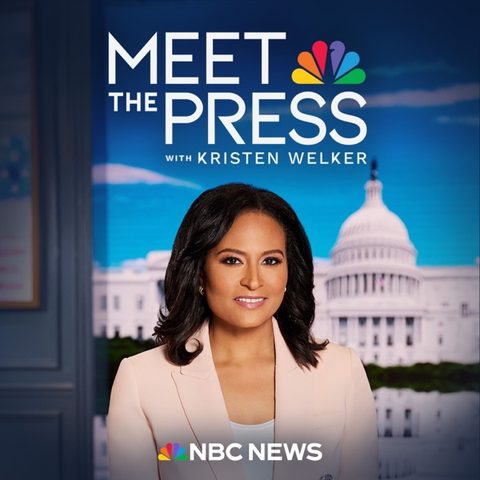
In one hour, Kristen Welker's show ties a market slump, Trump's Putin and Xi comments, a federal cyber breach and the new Democratic Congress into a single briefing.
“I say you just got to deliver people.”
Jennifer Granholm · at 43:16 — ▶ hear it from here
“They're going to send things my way and I'm going to veto them.”
Donald Trump · at 35:10 — ▶ hear it from here
▸What this episode covers
Markets and the economy led the hour. The Dow fell more than 900 points, the Dow and S&P 500 entered correction territory, and the Nasdaq erased all of its 2026 gains. NBC's Brian Chung tied the slide to worries about AI spending, a Reuters report on NVIDIA's accounting, and Anthropic's shares falling almost 9% in their first full day of trading. Meanwhile, President Trump held a 90-minute press conference in which he credited himself for falling oil prices, defended the Iran war, and called his relationships with Vladimir Putin and Xi Jinping a strength.
The second thread is the new balance of power in Washington. Democrats will hold larger majorities than expected in January, and Trump said he would veto bills he dislikes while leaving room for deals on health care. Sahil Kapoor's review of recent midterms found that voters tend to punish the party in the White House, whether or not Congress passes much. Jennifer Granholm, a former Michigan governor and Biden's energy secretary, urged Democrats to pass narrow affordability wins that Trump might sign, and she said the Senate leadership fight should be settled by who can deliver results.
The final stretch covered security and the wider world. NBC News reported a cyber breach at the USDA that targeted the system used to pay farmers, and an NSA classified network was down for three days during maintenance. Ann Neuberger, a former Deputy National Security Advisor, argued that AI now speeds up both attacks and fixes, and that the White House should bring critical-infrastructure firms together. From Ukraine, Richard Engel said Kyiv increasingly sees Trump as leaning toward Putin, and he argued that Russia could stop the fighting on its own territory if it wanted to.
Have a recording of your own? Paste a link or upload it.
WhipScribe sends back a timestamped transcript, like the one on this page.
Every recording starts with a free preview. Full transcripts come in packs from $4 for 300 minutes. Uploads up to 10 hours or 5 GB.
▸Jennifer Granholm on Meet the Press: the answers
Who is Jennifer Granholm?
Jennifer Granholm
Jennifer Granholm is a former Democratic governor of Michigan who also served as secretary of energy under President Biden. She joined the show to discuss how Democrats should use their new congressional majorities.
Who is Ann Neuberger?
Ann Neuberger
Ann Neuberger served as Deputy National Security Advisor for Cyber and Emerging Technology in the Biden administration and is now a general partner at Andreessen Horowitz. She spent almost 15 years at the National Security Agency.
What did Jennifer Granholm say about Democratic affordability bills?
Jennifer Granholm said Democrats should deliver quick wins on affordability, such as the permitting reform bill, a minimum wage increase and a fix for Affordable Care Act subsidies, and then put those bills on Trump's desk. She argued that voters sent Democrats to Congress to get results, not to focus only on their own political fights.
“I say you just got to deliver people.”Jennifer Granholm · 43:16
What did Donald Trump say about Vladimir Putin?
At a 90-minute press conference after his Asia trip, Donald Trump defended his personal relationship with Russian President Vladimir Putin. He said Putin was very nice to him during the Russia investigation, which he called a hoax, and that he has fantastic relationships with Putin and Xi Jinping.
“I consider him to be somebody that have a very good relationship.”Donald Trump · 3:54
What did Richard Engel say about Ukraine?
Richard Engel, reporting from Ukraine, said Ukrainians increasingly believe Trump is on Putin's side. He argued the war is about Ukraine's independence and Russian occupation of about 20% of its territory, not a personal feud between Putin and Zelensky.
“This is not a personal spat between Putin and Zelensky.”Richard Engel · 12:44
What did Ann Neuberger say about Artificial intelligence?
Ann Neuberger said AI has reset the balance between cyber attackers and defenders, making it easier to find and exploit code flaws but also easier to analyze and fix them. She argued that the recent outages reflect well-managed organizations rushing to use AI to patch vulnerabilities, and that the White House should bring critical-infrastructure companies together to do the same.
“AI makes it far easier to find vulnerabilities in code and exploit those for attackers.”Ann Neuberger · 26:41
What did Meet the Press NOW report on the market selloff and the new Democratic Congress?
Meet the Press NOW reported that the Dow fell more than 900 points and the Dow and S&P 500 entered correction territory, while the Nasdaq erased its 2026 gains. The show also covered Trump's press conference defending his ties to Putin and Xi, a USDA cyber breach, and the larger Democratic majorities taking power in January.
Mentioned in this episode
PersonDonald Trump
PersonVladimir Putin
PersonXi Jinping
PersonJensen Huang
CompanyNVIDIA
CompanyAnthropic
PersonChuck Schumer
PersonChris Van Hollen
PersonBernie Sanders
PersonElizabeth Warren
PlaceUkraine
PlaceDonbass
Episode facts
Released
November 20, 2026
Length
52 minutes
▸Key takeaways
01The Dow fell more than 900 points, pushing the Dow and S&P 500 into correction territory and erasing the Nasdaq's 2026 gains.
02Anthropic's IPO, the biggest public offering ever, jumped about 30% on day one, then fell almost 9% in its first full day of trading.
03Crude oil fell about 20% from the start of November to close to $80 a barrel, with analysts linking part of the drop to the midterm results.
04The USDA suffered a cyber breach this week that targeted the system used to pay farmers, and an NSA classified network was down three days.
05Jennifer Granholm urged Democrats to pass affordability bills like permitting reform and a minimum wage hike, then dare Trump to veto them.
▸Questions this episode answers
Q1What did Jennifer Granholm say about Democrats working with Trump?▾
Jennifer Granholm told Meet the Press NOW that Democrats should deliver quick affordability wins Trump might sign, then put those bills on his desk. She named the permitting reform bill, a minimum wage increase and a fix for Affordable Care Act subsidies. She also said oversight of corruption matters, pointing to a bill that would bar members of Congress from trading individual stocks.
Q2What did Donald Trump say about Vladimir Putin after his Asia trip?▾
At a 90-minute press conference after his Asia trip, Donald Trump defended his personal relationship with Russian President Vladimir Putin and Chinese President Xi Jinping. He said Putin was very nice to him during the Russia investigation, which he called a hoax, and that he has fantastic relationships with both leaders.
Q3Why does Brian Chung say the AI trade is pulling down the stock market?▾
NBC business correspondent Brian Chung said the AI trade that had lifted stocks is now dragging the market down. Investors worry that a Democratic-controlled Congress could change data center buildout or AI regulation. A Reuters report that the SEC is looking into NVIDIA's accounting pushed its shares down almost 4% in one day.
Q4What did Ann Neuberger say about AI and cyber defense?▾
Ann Neuberger, who served as Deputy National Security Advisor for Cyber and Emerging Technology under Biden, said AI has reset the balance between attackers and defenders. She believes the recent outages reflect well-managed organizations rushing to use AI to fix vulnerabilities. She argued the White House should work with several hundred critical-infrastructure companies and AI firms to find and patch holes.
Q5What is Richard Engel's view on Ukraine and Trump's comments on Putin?▾
Richard Engel, reporting from Ukraine, said Ukrainian officials are increasingly convinced that Trump is on Putin's side. He described the war as about Ukraine's independence and Russian occupation of about 20% of its territory, not a personal feud between Putin and Zelensky. He said Russia could stop the fighting today if Putin wanted to, because the ground combat takes place on Ukrainian soil.
Q6Will Jensen Huang return to NVIDIA after Trump's comments?▾
Trump said he would like to see former NVIDIA CEO Jensen Huang apologize and then go back. NBC's Brian Chung reported that NVIDIA's board said on a Tuesday investor call that it had no intention of re-employing Huang, and that the same message was given to employees at a company-wide meeting. Huang had said he would be open to returning if the board felt it was appropriate.
Q7What did Jennifer Granholm say about the Senate Democratic leadership fight?▾
Jennifer Granholm said the fight between Chuck Schumer and Chris Van Hollen for Senate Democratic leader should be judged on results, not on age. She said voters want Democrats to pass bills and get a presidential signature, and that a generational change is less important than delivering for people. She noted that the December 1st secret ballot is still ahead.
▸Transcript
Our own transcript of the public episode, with a timestamp about every 90 seconds. Tap a timestamp to play the episode from there in the show's own player; the link button on a paragraph copies a link that opens this page there.
0:00Sideline reporter Holly Rowe here. Covering a game or planning a getaway, I trust Vrbo for my vacation rentals, no question. With Vrbo's 24-7 live support from real people, if I do have a question or the rare issue, I get answers fast, and I'm into that. So I'll save my questions for coaches, players, and even the occasional mascot. Well, they tend to be the strong, silent type. Well, that's my cue. If you know, you Verbo, official travel sponsor of the college football playoff. A Samsung Galaxy Z Fold 8, watch and tab, all for $0. One AT&T offer, three Samsung devices. How many gifts are we talking? I mean, sounds like three gifts, obviously, for one incredibly good price, but three incredibly good gifts.
0:43Tis the season for more savings. Learn how to get the Samsung Galaxy Z Fold 8, watch 9, and Tab A11 Plus 5G for one incredibly good price, but three incredibly good gifts. Tis the season for more savings. Learn how to get the Samsung Galaxy Z Fold 8, Watch 9, and Tab A11 Plus 5G, all for $0. Requires trade-in of $290 or more in eligible plan. Terms and restrictions apply. Subject to change. See AT&T.com slash Samsung for details. Welcome to Meet the Press Now. I'm Kristen Welker, and that was the closing bell on Wall Street. As markets tumble, the Dow falling more than 900 points. Both the Dow and S&P have now entered what's called correction territory, having fallen more than 10 percent since recent
1:32highs. The tech-heavy Nasdaq has fared even worse. It's now wiped out all of its 2026 gains amid concerns about the rapid growth of AI in the wake of Anthropic's mega IPO yesterday. It all comes as President Trump, alongside top administration officials, held a 90-minute wide-ranging press conference today addressing the markets, the economy, defending his relationship with Russian President Putin and Chinese President Xi Jinping after his trip to Asia, while also discussing his domestic priorities with Democrats set to take control of Congress. We're going to bring it all to you throughout this hour, but we do want to start with the economy, as President Trump tried to blame Democrats' midterm victory
2:15for the market woes, while trying to take credit for the recent drop in oil and gas prices. Crude oil prices have plummeted right since the end of the election. I wonder how that happened. Crude oil is down 20 percent since the start of November and now it's down to close to $80 a barrel and one of the largest drops they say in the history of oil. It's less than two years and we've created $25 trillion. We've made 25 trillion dollars. Now, with that being said, we've lost four trillion since the election because the world is not happy about the people that did well in the election. I wasn't on the ballot. I hope you remember that. Now, we should note oil and gas prices spiked because of President Trump's war with Iran, and analysts attribute the recent
3:12decline in part to the midterm results because of the renewed pressure now facing the White House to end the war. The war has also raised tensions between the president and his vice president after Vice President Vance blamed the war for Republicans' midterm losses. Today, President Trump defending his vice president comments while also doubling down on his Iran war strategy. Would you do it again? And absolutely the answer is yes, because we cannot allow Iran to have a nuclear weapon. Now, I saw that, but no problem there at all. Actually, it was a very accurate statement. The war drove up prices, fuel prices, far less than I thought. Today's news conference was also the first time we heard from President Trump
3:54following his meetings with President Putin and Xi. The president facing backlash from both sides of the aisle for calling the authoritarian leaders his friends, but today President Trump defending his personal relationship with America's biggest rivals. While you were there, you said that Putin is your friend. Russia, of course, is Iran's biggest ally. Do you believe Putin is a friend to America? I can't speak to America. I've been dealing with Putin during the fake Russia, Russia, Russia hoax. And to be honest, he was very nice about it. I consider him to be somebody that have a very good relationship. And it's actually very good. I consider I have fantastic relationships with Putin. That's a very good thing.
4:35I have fantastic relationships with President Xi. That's a good thing. And our country is safe because of that. Joining me now is NBC News Kelly O'Donnell at the White House, NBC News business and data correspondent Brian Chung, and NBC News chief foreign correspondent Richard Engel, who's in Ukraine. Kelly, let me start with you. You and I were watching that news conference together. What were your biggest takeaways? Good to be with you, Kristen. And first, I am at an event on the South Lawn and the Marine Band is playing now. So if it's a little dissonant from some of the other elements of your program, that's the reason we're covering this event while coming to you. Big takeaways. The president certainly doubling down, as you described it,
5:18in his relationships, the power of relationship with leaders that do not have much in common with the United States, Vladimir Putin and Xi Jinping. The president also talking about what he claims were results from his meetings, that the quality of the personal relationship leads to other kinds of advantages, saying that they can talk about things like nuclear proliferation, various deals. And the president again hinting at what he asserts is Vladimir Putin's willingness to end the war in Ukraine. And yet we don't see any evidence of that on the ground and in the region. And certainly Richard will speak to that. The president also made some claims about his ability to work with Democrats, knowing that they won in a very
6:02significant margin for the new Congress coming in in January and saying he could work with them on things like health care. Well, remember, health care has been an issue the president has talked about since before his first term in office, so more than a decade now, and has never put forward a health care plan, but now claiming that because of the power of veto, which the president has, to work as a counterweight to the strength the Democrats have, that maybe they can make some deals. So on foreign policy and domestic policy, on leadership qualities, and on his vision for these next two years, the president was in effect a hype man for the trip he just had and for what is still achievable in his two years remaining on his term.
6:44Kristen? So many news-making comments that we heard there. Kelly O'Donnell powering through, of course, all of the loud sounds coming from the White House, the Marine Corps band there we hear behind you. Kelly, stand by. Let me turn to Brian Chung. So, Brian, markets just closed red across the board. The NASDAQ now teetering in a bear market. What's the very latest, and what are the broader implications here? Yeah, and just to remind people, there are actual definitions for that type of stuff. So a bear market will be down 20% from its most recent highs. We're not there yet on the NASDAQ, although we are down pretty significantly from those highs on that tech-heavy sector. But the Dow Jones and the S&P 500 just today,
7:25closing the day of trading in a correction territory, that means it's down 10% from the most recent highs. That's certainly still nothing to, you know, to balk at. And again, the big story here is the artificial intelligence trade. We've been talking so much about how AI has been buoying the stock market in the recent months, but it's also been what's pulled down the market in the last few weeks because of the concern around, A, you have the midterm elections where a democratically controlled Congress now has some wondering if the data center buildout or regulations around AI are going to change dramatically in a way that could slow down a lot of these high-flying AI tech stocks. And then you also have, of course, what's going on with
8:03NVIDIA. Shares of that company down almost 4% just today off of a Reuters report suggesting that the SEC is looking into that company's accounting practices. They cited two people familiar with the matter. NVIDIA did not respond to a request for comment on that. But then, of course, Anthropic's IPO yesterday, the biggest public offering ever. That shot up by like 30 percent in one day. But in today's first full day of trading, shares of Anthropic came back down to earth, down almost 9 percent for the day. So it seems like investors are trying to figure out where are the investable opportunities in AI as they get a little bit more conservative about the AI trade, taking the overall markets down with it, Kristen. Yeah, really notable, remarkable activity
8:45in the market this week. I do want to ask you, Brian, because President Trump talked about data centers. He made some notable comments there. We're going to play a little bit and get your reaction on the other side. Take a look. You want to take advantage of the data centers, make them pay you, make them pay your community, but take advantage. Don't shut them off. And we're not going to allow companies to build data centers in other countries. If they do that, they can, but we're going to put a tremendous tax on them if they do it. We want them to build it here. How are you expecting industry leaders to respond to those comments, Brian? Yeah, well, again, going into the midterms, it was a relatively hot topic. And
9:25even if not the first topic, of course, the economy was top of mind for voters. But data centers in people's backyards was a very much hot topic that you saw in some of the campaigning going into the midterms. Now, the president is trying to defend the data center build out while a lot of Democrats won on the basis of trying to stop a lot of these data centers from being built. And I think that the question here is how aggressively will the president be able to move forward on some of the data center build out, given that he is going to need Congress's help if they want to try to subsidize some of the resources to encourage that build out. Now, the president also saying that he doesn't want those companies or will somehow forbid
10:02companies from building overseas is very much an open question. I've been talking with a lot of big tech companies over the last few months that have said their build-out in the U.S. is just as aggressive as they are in the other corners of this world because these are global companies after all. You look at Google, for example, building out a data center in Finland where they've been getting pushback, actually ordered to halt reportedly one of those data center build-outs. They're really hitting a wall in terms of every corner of this country. And it seems like the president's going to make that probably harder by trying to put these fences around the data center buildout, Kristen. Yeah, it was a big flashpoint in the midterms, continues to be a hot topic of discussion.
10:38That's for sure, Brian. Let me also ask you about these comments that President Trump made about the former CEO of NVIDIA, Jensen Huang, who, of course, stepped down amid controversy. He said he'd like to see him, quote, apologize and then go back. Is that realistic? Is that what the board of NVIDIA wants? Yeah. And the president saying and making those remarks in that press conference earlier this afternoon, he also said in those same remarks that he feels like people deserve second chances. But you have to remember what NVIDIA itself said on Tuesday on a call with investors. They said that the board had no intention to re-employ Jensen Huang. And a source that was in the room for a company-wide meeting on Wednesday
11:19told me that that same message was telegraphed from the board and from executives to the employees, saying there is no intention to bring Jensen Huang back. Of course, the chatter built up because we heard from Huang himself in his first public statement since all of this began, saying that he would be open to coming back to NVIDIA if the board felt it was appropriate. The board clearly doesn't see that as appropriate right now. But, Kristen, I think what was so interesting was the president did also say in those remarks that he did talk to Chinese President Xi Jinping about it earlier this week. But that actually contradicts what we heard from the Treasury Secretary Scott Besson, who appeared on CNBC in the morning saying that Huang did not come up in those discussions. So
11:57a bit of cross wires on that point. Yeah, there certainly is. It continues to be obviously one of the big stories that the White House and the entire world is watching, giving the impact of NVIDIA on the global economy. Thank you so much, Brian Chung. We really appreciate it. Richard Engel, let me turn to you. What reaction are you hearing from President Trump's news conference where you are and what are your Ukrainian sources telling you, given the fact that we heard President Trump double down and defend his relationship with President Putin? I've been speaking to Ukrainians, Ukrainian officials about this entire visit to Asia, also his latest press conference, and it has left Ukrainians very concerned,
12:44a concern that they've had for a long time, that President Trump isn't Ukraine's ally, that President Trump is close to Vladimir Putin, favors Vladimir Putin, wants to do business with Vladimir Putin, wants to make money for himself and his family with Vladimir Putin, and is portraying this conflict as if it is some personal spat between Putin and Zelensky. This is not a personal spat between Putin and Zelensky. This is a war because Russia invaded this country five years ago almost and continues to occupy about 20 percent of the territory. Of course, Putin and Zelensky do not get along. I was with Zelensky a couple of days ago and he made that quite clear. But this is not some personal fight like you would see in a relationship. This is about
13:39Ukraine's independence. And Ukrainians are not just worried, they are increasingly convinced that President Trump is not on their side, but is on Putin's side. Well, we also, to that point, heard President Trump say he believes President Putin wants to end the war. And yet hours after the summit, maybe not even hours, Richard, we saw Russia attack Ukraine yet again. What's the reality on the ground there? President Trump keeps saying that, that Putin wants to end the war. If Putin wants to end the war, it would be very simple. He just simply has to stop the war. It is not Ukraine that is invading Russia. All of this conflict is taking place on Ukrainian territory. There are some long range Ukrainian attacks where Ukraine
14:35has attacked Russian infrastructure, Russian military bases. But the fighting, the ground fighting, the Russian troops, the Russian troops, the Russian artillery, the Russian tanks, they are all on Ukrainian territory. So if Russia wanted to stop the war and Putin wanted to stop the war, he could do it today. So we've heard this before that he wants to, but he is finding it difficult. President Trump, again, using kind of personal relationships, said the two sides are stuck in this conflict and don't know how to get out of it. That is not at all the way it is seen here. Ukrainians want this war to be over because they want Russian troops to leave and to leave them alone. They want to have an end to open-ended drafts. If you're in Ukraine right now and you're a military-age male,
15:27you could be stopped on the street, sent into the military for an open-ended period. It is not that you are drafted here for six months or a year or two years. You are drafted here until the end of the war. So Ukrainians certainly want this war to be over far more than Vladimir Putin does, according to President Trump. One of the asks of Ukraine is that there are security guarantees as a part of any potential deal. We know that the president's son-in-law, Jared Kushner, participated in talks in Berlin yesterday. I want to play a little bit of what he had to say about that, Richard, and get your reaction on the other side. Big development that we've been able to achieve. And I think we've gotten the Russians comfortable with that concept where any security guarantee for Ukraine would be based on Article 5.
16:19And I think that that comes with at least what the Russians are saying, which is their intention is when this war is over to not have another war in the future. Is that something that you're hearing as being realistic security guarantees? Absolutely not. This is something that that Jared Kushner is talking about. Some sort of NATO-like guarantee. Article 5 means that an attack on one country is like an attack on all. So it is the core of NATO. But that is not something that Russia has agreed to. In fact, Russia has ruled out any NATO agreement or NATO-like agreement for Ukraine. What I'm hearing from Ukrainian officials is that there is more pressure being put on President Zelensky to give up the Donbass,
17:12to surrender territory in eastern Ukraine, to placate Vladimir Putin as a way to end this war. But Ukrainians do not believe that Putin will be satisfied with a little bit more territory, that he wants to dominate Ukraine, whether it is in this conflict or in a future conflict weeks, months or years down the road. All right. Richard Engel reporting in Kiev and, of course, coming off of the heels of your big exclusive interview with President Zelensky just a few days ago. Richard, thank you so much for that reporting and perspective. We really appreciate it. Kelly, let me turn back to you at the White House. You and I talked about the fact that the president touted, yes, his trip to China, but he also talked about some of his domestic priorities as well. What were some of your
17:59takeaways there? Well, he certainly did. And they're singing Amazing Grace now. So I'm going to try to keep my voice low to not be disrespectful to those who want to hear this. On domestic priorities, the president talked about what he believes are already falling prices in the area of gasoline. That's critically important with the affordability question. As I mentioned before, he is touting the potential for policy on health care. That remains to be seen what that would look like, how it would take shape. As you know, Democrats have been very much concerned about cuts to Medicaid and how that's had an impact in rural America. And certainly rural America changed some of its votes in the direction of Democrats, whether it was for Democrats or against this administration.
18:44That remains to be determined case by case. But those kinds of issues are clearly very important. The president also believes that there is great job creation by having companies, especially in the area of data centers, making those data centers in the United States. That's also an area of some interesting conflict because many Americans let it be known during the midterm season that data centers are a source of concern in communities. Noise, drain on electricity, drain on water, those kinds of things. The president is saying those should be built in the United States. And he's even went so far as to say he would forbid U.S. companies from building them in other nations. That remains to be seen if he can do it.
19:25He can certainly incentivize building in the U.S. But those are some of the issues that affect economy, affect health care, affect everyday lives in America that the president did touch on today. And it will be one of the issues about how effectively can he work with Democrats in control. He spoke favorably of Hakeem Jeffries. The incoming speaker called him streetwise and smart, talked about his long relationship with Chuck Schumer and being a past donor to Schumer, of course, from his New York days. So he is at least opening the door to acknowledging Democrats. One, Democrats are part of the equation in a very big way going forward. And if he wants to be successful in the next two years, he needs to find a pathway.
20:09Unclear when he will have those Democratic leaders here to the White House. That was something he was asked. And there was no definitive answer on that yet. Kristen. All right. Kelly O'Donnell, no one has mastered the art of voice modulation like you, my friend. Thank you, Kelly O'Donnell, for powering through. We really appreciate it. And coming up, the White House fires its national cyber director in the midst of a series of high-profile outages. We learned this afternoon that a key federal agency was also hacked. Plus, President Trump says he's open to working with Democrats, as Kelly was just talking about, when they take control of Congress. But is compromise really possible in this political environment with 2028 now on the horizon?
20:49You're watching Meet the Press Now. Modern enterprise. That's a lot of moving parts. Comcast Business helps you orchestrate it all. With SD-WAN working at scale to keep 150 hospital locations connected and working as one. Plus SASE and Zero Trust Security protecting financial data across a bank's 2,000 branches. And AI-powered networking that optimizes traffic across five continents. No one does business like Comcast Business. More people, more devices, more AI. The way we live today takes a lot of energy. Wind and solar are powerful, but not always available. That's where natural gas comes in, with reliable energy whenever it's needed. Companies like Energy Transfer work behind the scenes,
21:44safely transporting these resources to facilities across the country through a network of underground pipelines. Learn more at ittakesenergy.com. Big news! Wayfair's Black Friday sale is here! Right now, get up to 80% off everything you need for the season ahead. Save on kitchen and dining, bedroom furniture and mattresses, seasonal decor, and way more. All at Wayfair. These are Wayfair's best deals of the year. From seasonal finds to favorites you'll use all year long. Plus, enjoy fast and free shipping with delivery in time for the holidays. Save up to 80% off during Wayfair's Black Friday sale. Now at Wayfair.com. Wayfair. Every style, every home. Welcome back. NBC News has learned the United States Department of Agriculture was the victim of a cybersecurity breach this week,
22:38with two former USDA officials saying the breach targeted a system used to handle payments to farmers. Now, it comes in the wake of a series of tech outages impacting major companies and other government agencies, though those outages have been attributed to system upgrades. A source telling NBC News the National Security Agency has now restored an internal classified network that went down during maintenance work that caused a three-day disruption of that system. The president today aiming to reassure the public that those recent outages were not the result of a coordinated cyber attack. They're all separated. They're not like, oh, gee, Chase went down and this one went down. They're all separate events. They're all separate events. You know, we have
23:23thousands of companies that are upgrading right now. And when they upgrade, bad things happen. The president also announcing today Kristen Davies as the new White House cyber director after he fired Sean Cairncross, who the president said in his news conference today was not up to the job. Joining me now on set is senior Homeland Security correspondent Julia Ainslie. Julia, thank you so much for being here. So what more do we know about this potential hack at the USDA? This one might be the most serious. I know there's a lot of fatigue for viewers right now because it's been a week of hearing about one after another, but this one is different because it's the first one that appears to be a cyber breach, meaning an outside actor found a vulnerability and was able to access information on USDA system. The system went down because USDA took this down
24:11to try to block whoever it was from getting personal information. Now, the system itself doesn't sound very serious. It deals with how farmers get payments from USDA. But these former officials I spoke to who are really familiar with the way tech works at the agency says that once you can get that far, it's very easy to get into other systems. And so they're worried about other things they might have accessed. Julia, put it into context for us because we've been talking about all of these other tech outages this week. How does this one at the USDA differ from all of those other ones. Right. It's because of what it could mean. Because if they're able to get access to that system, they could also get access to, for
24:51example, how we do food safety inspections in the United States. And the most serious one, this is the one that is keeping these former officials up, is to be able to get access to research, highly secure research into animal-borne illnesses that the U.S. has spent years trying to do and understand, as well as just how to grow plants better. What could happen if there's a potential blight on plants? There's a lot there that could really affect the food supply of the United States, and it's a scary thing when someone gets that access. One of these officials said when they were there, they constantly saw attempts by outside actors, including Russia and Iran and other places. But this is as far as they've ever seen anyone get inside the system. constantly saw attempts by outside actors, including Russia and Iran and other places.
25:30But this is as far as they've ever seen anyone get inside the system. It comes as the IT department at USDA was taken down by a third under Doge. So, Julia, just big picture, looking forward, we know lawmakers have been calling for briefings on this. What are you going to be watching for in the coming weeks as it relates to these tech outages? Well, I'll be watching to see if Congress will really come together, given the results of the midterms, given what's happening around the country, this outcry from people. Even though the president has been giving some assurances to people, as you saw from the podium today, there seems to be a real understanding in Congress that something needs to be done on this quickly. And
26:01they're eager to show the American people that they understand that cybersecurity also means economic security. So perhaps we'll see something either in the new Congress or in the lame duck to see if there really could be guardrails or a revamping of critical infrastructure to now see cybersecurity as just as important as our missile and defense system. Julia Ainsley, thank you for joining us on this developing story. We really appreciate it. Joining me now is Ann Neuberger. She served as Deputy National Security Advisor for Cyber and Emerging Technology during the Biden administration and is currently General Partner and Head of Global Affairs at Andreessen Horowitz. Thank you so much for being here. We really appreciate it.
26:41It's great to be with you, Kristen. Well, it's wonderful to have you, Anne, and I do want to start with these tech outages. The president says these are all individual events, that they're not connected. They are due to software updates and old equipment that's basically being replaced. What do you make of what's happening? Do you think that that makes sense, or do you think that there's potentially something nefarious going on here? Good question. So AI has really reset the table for both attackers and defenders in cyberspace. AI makes it far easier to find vulnerabilities in code and exploit those for attackers. It makes it far easier for defenders to analyze every line of code and fix holes in
27:23them. So I believe what we're seeing right now is well-managed organizations rushing to use AI to fix vulnerabilities in their code to get one step ahead of attackers. And do you think there's a way to prevent this and certainly to prevent this from happening all at the same time with all of these various different companies and entities. I think that's part of what's making Americans feel so nervous right now. Exactly. So Americans are rightfully concerned when you see a string of outages like we've seen, and they really are a call to action to take a step back and look, as you said, Kristen, to look at it across the nation and say Americans want to have confidence that the critical services, power, water, pipelines, hospitals
28:10that all run on America's digital infrastructure are secure. And the way to really address that is for the White House to work with several hundred companies and their direct suppliers to essentially ask them that direct question and then bring those companies together with AI firms to use AI to find and fix vulnerabilities in their code, to patch those vulnerabilities. If they can't be patched, you can bring, kind of build an AI defense around it so that we have the confidence as a country that those critical services can be disrupted and that the kinds of things we have today across critical infrastructure, where we have fragile systems, where we often have poor cybersecurity, that we work with urgency to use AI to address those so that Americans have the
28:57confidence they deserve to have that critical services will be resilient even in the face of AI-driven machine attacks. Well, let me ask you specifically about the National Security Agency, because there we saw a key internal communication network. It's now been restored, but it was down for three days, Anne, because of what they say was a maintenance issue. Talk a little bit about why that system is so significant and the implications of it being down for three days. Absolutely. So I served for almost 15 years at the National Security Agency. And indeed, it is significant because the National Security Agency carries classified information. And as such, given the criticality of its mission, those are systems that as a country,
29:41we need to be operating 24-7. With that said— I'm sorry. Keep going. I was going to say, with that said, the National Security Agency runs a global network using the same kind was aggregating all of these patches from its various vendors and working to quickly apply them. And when you apply many patches at once, each one is a piece of software. And when you apply many patches at once, Microsoft, for example, has made available 10 times as many patches as a year ago. Sometimes you get unexpected effects as one patch cancels out another or achieves, you know, contradictory impact. So that's likely what was going on, particularly at a very large global network like NSA. And it's great to hear it's back up and operating
30:35and with more secure against the kinds of vulnerabilities that AI can find and exploit. So do you think that national security could have been compromised during that outage? It's hard to know. I don't want to speculate. But the good part is that classified networks are built with ear gaps, separation from the public internet. So as such, even if the network is down, that separation between the network and the Internet, which is what attackers might want to use to access it, still remains secure and in place. Let me ask you about an opinion piece that you published this month. I'm going to read part of it to you, get a little bit more of your analysis on the other side. You write, AI is shrinking the time between when a weakness is
31:25found and when attackers can exploit it. Defenders who still work at human speed will lose that race. We should note that NBC News has confirmed the USDA was the victim of a cyber breach this week. Do you think America's defenses are ready for a major cyber attack should its agencies be targeted? If they stay the way they are, no, they are not. Because America's cyber defenses were built for human attackers, even human attackers that automated the steps of an attack, like studying a network and finding vulnerabilities. Today, what AI has changed is that AI brings machine power to attacks, doing the very same steps, which makes attacks more attacks, deeper and more complicated attacks. In many ways, it allows attackers to jiggle every digital doorknob continuously and at scale.
32:17The answer is AI-driven cyber defense. So we do machine against machine. And indeed, in some ways, defenders have the advantage. They have their own code. They know their networks better. So when they're applying AI to find vulnerabilities, to analyze every line of code and fix code, they'll be able to do it one step ahead of attackers, but we need to act with urgency. And that's why we need the White House to bring, you know, the several hundred companies that operate critical infrastructure together to do this, those series of steps to ensure that we have AI driven machine level defenses in place to counter those attacks. Ann Neuberger, thank you so much for joining us, for your insights and your expertise.
32:58We really appreciate it. Thank you so much for having me, Kristen. Up next, the dilemma facing Democrats. We'll dive into the political ramifications as Democrats debate working with President Trump or fighting him when they take control of Congress. Stay with us. You're watching Meet the Press Now. If you like YouTube, you'll love YouTube Premium. It's destroying athlete, creator, and YouTube maxer. YouTube Premium enhances how I use YouTube with awesome features like offline downloads so I can download my favorite training videos before I hit the gym. So no Wi-Fi doesn't turn leg day into loading day. Plus, I get ad-free videos, background play, and so much more. YouTube Premium is like YouTube got some extra gains.
33:40Try YouTube Premium for two months free at YouTube.com slash premium. Trial eligibility varies. Terms apply. Cancel anytime. Most women wait years before seeking relief from menopause symptoms. Menopause happens, but the suffering doesn't have to. Alloy was built by women who dealt with all of it. It's an all-in-one platform that provides expert care and real, effective treatment. Complete a simple online intake, get matched with a menopause-specialized doctor who creates a treatment plan and provides unlimited messaging support, and once approved, your prescription ships straight to your door. Join the women who found real relief. Head to myalloy.com and use code SXM20 for 20% off your first order.
34:21Valid on products only. Big news! Wayfair's Black Friday sale is here! Right now, get up to 80% off everything you need for the season ahead. Save on kitchen and dining, bedroom furniture and mattresses, seasonal decor, and way more. All at Wayfair. These are Wayfair's best deals of the year. From seasonal finds to favorites you'll use all year long. Plus, enjoy fast and free shipping with delivery in time for the holidays. Save up to 80% off during Wayfair's Black Friday sale now at wayfair.com. Wayfair, every style, every home. Welcome back. Democrats are gearing up to take control of Congress with majorities that were unthinkable just a year ago. And the biggest question hanging over American politics is how are they going to wield that power?
35:10In the Senate, Democrats will have a six-seat majority after flipping nine seats in the midterm wave. Their House margins are larger. NBC projects a 40-plus seat majority. For reference, the current Republican majority is two. The White House, of course, remains red, leaving Democrats debating how much, if at all, to work with the president and how voters will react to their choices. Earlier today, the president addressing whether he sees room for bipartisanship. They're going to send things my way and I'm going to veto them. And then they're going to send more things and I'm going to veto them. And they could go two years and one month because that's what we have. And I'm going to veto them.
35:50But I think after a month or so, they're going to send things and I'm going to say, I'm going to veto unless you want to do this and this and this. If they want to get things done, I want to get things done, too. You know, there are those that say we might get more done because we had some Republicans that were just impossible to deal with. Joining me now at the big board is senior national political reporter Sahil Kapoor. So we are going to have divided government. How do voters typically respond to that, Sahil? That's right, Kristen. We've seen plenty of divided government over the last dozen years. And generally, voters have tended to respond by blaming the party in the White House when things don't go their way. Divided government
36:31usually produces gridlock. There tends to be an assumption that the party that just won the midterms has to prove that it can govern and deliver results. I want to test that proposition. Is that really how voters think? Let's go back to the 2014 midterms. Big red wave. Republicans win full control of Congress. What ends up actually happening? 172 substantive bills. This is well below the average of 236 substantive bills. We're not including the ceremonial renaming of post offices. What actually happened in Congress? These are some of the highlights. They did a surface transportation bill, a Medicare bookkeeping fix. There were a lot of fights, including the Merrick Garland blockade of Barack Obama and Mitch McConnell having that stare down over the Supreme Court vacancy.
37:09ACA repeal show votes more than I can count. Overall, not the most productive Congress. And how did voters respond? Did they punish Republicans? Not at all. They rewarded them with the White House and the trifecta. An unproductive Congress, but still Republicans won the White House because voters punished the Democrats who were the party in the White House at the time. Let's fast forward. Donald Trump's first midterm 2018, Democrats win about 40 seats, capture control of the House of Representatives while campaigning on giving voters more health care, better wages, what actually happened in the Congress. Again, not a very productive substantive Congress. There were a lot of COVID relief measures passed during the pandemic. There was USMCA a little bit before that, which is essentially an updated and tweaked
37:48NAFTA. Once again, a lot of fights, which including up until that point, the longest government shutdown in American history, the Trump impeachment, not a very productive Congress after Democrats captured control. But were they punished for it? No, they weren't. They ended up winning the trifecta in the 2020 presidential election. Once again, voters punished the party in the White House when the results weren't coming. Let's fast forward to 2022. Republicans here, Joe Biden is president. They win the House of Representatives. They capture control away from the Democrats. This ends up being an extraordinarily unproductive Congress, this 84 substantive bills. It's about a third of the average over the last
38:23four decades. These are some of the highlights here. Foreign aid being one of them, spending caps being another. A lot of fights here, including the leadership chaos within the Republican Party that toppled Speaker Kevin McCarthy in the middle of the session. So an extraordinarily unproductive Congress after Republicans won the House of Representatives. Did Republicans get punished for it? Not even a little bit. They won the trifecta and Donald Trump won every swing state. So we've seen the last three midterm elections, the party that wins does not actually end up having to deliver in order to win the White House. The point being, voters punish the president's party when things aren't going well. It's just how they're wired,
38:59whatever the real reason is for the gridlock. Well, it's a fascinating look back, Sahil. Do you anticipate those trends will continue as we watch these Democrats take control of Congress and, of course, head into 2028? Yeah, that gets us to present day, Kristen. And this is where we have the blue wave that just happened. Democrats are on pace to win as many as 260 House seats if the ones that are ahead end up coming through. Fifty six seats in the Senate. Now, the big question the ones they're ahead end up coming through, 56 seats in the Senate. Now, the big question is what they're going to do with this. What's actually going to happen? Are they going to deliver on affordability? Are there going to be bills to lower the cost of
39:34health care, to bring down gas prices? That's very much an open question right now because what the Democrats want to do is oppositional and confrontational to President Trump, such as ending the Iran war and restoring his health care costs. So it's not clear we're going to see much happen. And the point, the biggest point here, Kristen, that history tells us is that the onus is going to be on President Trump to find a way to work with the Democratic Congress, because if he fails, history tells us that voters will punish his party and end up electing Democrats in the 2028 election. I expect this bucket to be very lively. There are going to be investigations, a whole bunch of confrontations between Democrats and the White House.
40:13The question is, can they find a way to get results in the midst of all of that? And what will it end up meaning for the 2028 election? Kristen. That is the big, big question, Sahil. I know you'll continue to track it fight by fight, twist and turn. Sahil, thank you so much. We're going to dive deeper into those very questions surrounding the Democratic Party's agenda with former Michigan Governor Jennifer Graham-Holme, who joins us next. If you like YouTube, you'll love YouTube Premium. Hi, I'm Sean Evans from Hot Ones, and I want to tell you about YouTube Premium. It has offline downloads, so you can watch without Wi-Fi. Background play, so you can lock your phone, and it still plays, baby.
40:57Oh, and it is completely ad-free. Yes, I said it, ad-free. Try YouTube Premium for two months free at youtube.com slash premium. Trial eligibility varies. Terms apply. Cancel any time. Most women wait years before seeking relief from menopause symptoms. Menopause happens, but the suffering doesn't have to. Alloy was built by women who dealt with all of it. It's an all-in-one platform that provides expert care and real, effective treatment. Complete a simple online intake, get matched with a menopause-specialized doctor who creates a treatment plan and provides unlimited messaging support, and once approved, your prescription ships straight to your door. Join the women who found real relief.
41:40Head to myalloy.com and use code SXM20 for 20% off your first order. Valid on products only. Big news! Wayfair's Black Friday sale is here! Right now, get up to 80% off everything you need for the season ahead. Save on kitchen and dining, bedroom furniture and mattresses, seasonal decor, and way more. All at Wayfair. These are Wayfair's best deals of the year. From seasonal finds to favorites you'll use all year long. Plus, enjoy fast and free shipping with delivery in time for the holidays. Save up to 80% off during Wayfair's Black Friday sale now at Wayfair.com. Wayfair, every style, every home. Welcome back. Turning now to the battle to lead Senate Democrats, Democratic Senator Alyssa Slotkin now says she is supporting Senator Chris Van Hollen's bid for majority
42:30leader against Chuck Schumer, making her now the fifth senator to call for a change in leadership. Clearly after the election we just had earlier this month, I think that message was sent loud and clear. The American public want a new generation and they want big and bold ideas. Senator Schumer, though, insists he has the votes to win the December 1st secret ballot election. Joining me now is former Democratic governor of Michigan, Jennifer Granholm. She also served as secretary of energy under President Biden. Madam Secretary, thanks for being here. We really appreciate it. You bet. Thanks, Kristen. I want to start with that leadership fight in the Senate. You have allies of Chuck Schumer saying, why would we replace the
43:16coach, basically, who just won the Super Bowl? But you have supporters of Senator Van Hollen saying it's time to take the party in a new direction. What say you? Where do you stand on this? I say you just got to deliver people. I mean, I don't know that citizens really care whether it's Schumer or Van Hollen. What they care about is we put you all in there. You got a blue wave. Deliver. And, you know, the generational change, I get it. Totally get it. People want change. But do they want, you know, generational change? I get it, totally get it. People want change, but do they want generational change? I mean, when you say generational change, you think you don't want old people, but I think people think Bernie Sanders is a change agent and Elizabeth Warren is a change agent.
43:56It's just about how much you're going to be able to deliver for people, not necessarily the actual age of the person. Who do you think would be better, or do you have a sense of who would be better, to lead Democrats in this moment? Have you decided if you were going to advise one of the senators who's going to vote? This is not my... I'm not there. So, you know, I think that competition is a good thing. It makes everybody sharper and, you know, let them figure it out. But what I really want to see is the ability to deliver, to pass stuff and get a presidential signature. So, for example, Kristen, I mean, we saw yesterday there was this vote on the permitting reform bill, which is the product of a bipartisan compromise.
44:42And I feel like it is the low part of the low hanging fruit that these members should vote for because they were sent on affordability. And this is a bill that will bring down electricity rates and we'll get more clean energy on the grid. Let's do that as part of what we have to do moving forward. It's a quick win. Let me follow up with you on that point, because it was notable today. President Trump, in his news conference, said, yes, he's willing to use his veto power, of course, but he also said he believes there is a possibility that he can get something done with Democrats. Now, he mentioned healthcare. He didn't get specific. But do you think that there's an area of common ground on an issue like health care?
45:29And should Democrats try to fight for something narrow? I think if they bring something sweeping to him, that's not going to pass. But something. Yeah, no, you're totally right. I mean, I think that there are some singles that Democrats can hit right out of the park. I mean, this this permitting reform bill is one of them. A second one would be figuring out a way to fix the subsidies for the Affordable Care Act, because two million people are going to either see their premiums go through the roof or lose their health care. So that's a fix. He has said he is willing to work. Let's take him at his word. Let's put it on his desk. A simple bill like raising the minimum wage for Pete's sake, it's seven whatever dollars an hour, put it on his
46:11desk. Hit that one out of the park. The notion of, well, tariffs probably wouldn't get his support, but getting Congress to support having more authority over where tariffs are applied and over what, I think is something that Democrats should put up. Have a series of affordability bills that you put on the table and dare him to veto them. But hopefully he will actually sign them like he would, I think, this permitting bill. You mentioned the minimum wage. President Trump has in the past expressed a willingness to support an increase on the minimum wage. I interviewed Senator Bernie Sanders, who we were just talking about a couple of weeks ago. He raised the minimum wage when I talked about what is an issue where you think you can find bipartisan ground with
46:55President Trump. I mean, should that almost be the permitting reform bill you're talking about? But should that almost be a starting point, Madam Secretary? Yeah, it's easy. It's an easy win to be able to get that. You know, I think, honestly, there are a series of things that you would certainly, I think, get bipartisan support in Congress for. And if it's an overwhelming amount of bipartisan support, you might get the president's signature too, certainly on things where he's expressed a desire to actually move forward or a willingness, like the permitting bill, like minimum wage, like on health care. I mean, he said that he'd be willing to take a look at health care. What does that look like?
47:33Let's go. And then, you know, you can also set up, the Democrats can, more visionary bills. You can do both, right? But people want something done. And despite Sahil's report that he just gave to you about Democrats not having to do a bunch of stuff that's on the president, Democrats who are elected, they want to get stuff done. They want to be able to go back and say, I voted to raise the minimum wage. I voted to get health care fixed. So I think you can do both. And Democrats are in a good position to do that. You also have some Democrats making it very clear they plan to investigate, they plan to conduct oversight over the Trump administration. There's a big debate brewing right now inside the Democratic Party
48:15about how robust that oversight should be. What do you think oversight should look like in this new Congress? And are you concerned that it could come at the expense of getting something done on affordability, which is the number one issue bar none for voters? Absolutely. But they have to do both. I mean, people, corruption is an affordability issue, too. And so oversight over corruption, I think, is important. And by the way, this is another bill that the Democrats can put forward, which is the Stock Act, which prohibits members of Congress from trading individual stocks. I think everybody out there in the real world understands the conflict of interest of that. We're seeing it every day with respect to the Trump administration.
48:57So let's put that up as well. But yes, you can do oversight and you can make sure you root out corruption and say that this is a message going forward. We're not going to tolerate that kind of self-dealing. And we're also going to address affordability in other ways as well. You can do both. I'm confident the Democrats understand that and are planning on moving forward on both. Well, I'm going to ask you this final question. You're probably not going to answer it, but on 2028, anyone who you particularly would like to see get in the race who you think might be the standard bearer? They're going to be potentially over 20 candidates. 31 flavors, as Rahm Emanuel says. I say let the competition begin. I'm looking forward to the debates. They won't be able to put everybody on one stage. It'll be bigger than the last time. So great. Competition is a good thing. As a former governor, do you think it should be
49:50a governor? I like governors. I have a bias. You know, they know how to get stuff done. But I'm not saying others don't know how to get stuff done, too. So we got some great candidates and I'm excited about that. All right. Secretary Granholm, thank you so very much. All right. We're going to talk about all things Congress in 2028. The early jockeying, of course, well underway in both parties for who will be running for the White House today, flanked by two potential 2028 presidential contenders. President Trump dodged a question on who he thinks should succeed him. Look, you have the vice president and the secretary of state right behind you. I'm curious, which of them do you think would make a better president after you? THE PRESIDENT'S DECISION TO SUCCEED IN THE ELECTION. HE'S BEEN ABLE TO DO THAT. HE'S ALSO RELEASED A QUESTION
50:26ON WHO HE THINKS SHOULD SUCCEED HIM. LOOK. YOU HAVE THE VICE PRESIDENT AND THE SECRETARY OF STATE RIGHT BEHIND YOU. I'M CURIOUS WHICH OF THEM DO YOU THINK WOULD MAKE A BETTER PRESIDENT AFTER YOU? LET ME GIVE YOU THE ANSWER TO THAT. JOINING ME NOW IS OUR PANEL, DANIELA DIAZ, POLITICS REPORTER FOR THE WASHINGTON SON, ANDREW BATES, FORMER WHITE HOUSE DEPUTY PRESS SECRETARY IN THE BIDEN ADMIN Biden administration, and T.W. Arihi, Republican strategist and vice president of Push Digital Group. Thanks to all of you for being here on this Friday. Great to see you, Daniela. Let me start with you in this remarkable seat at this news conference. President Trump flagged by his vice president, Secretary Rubio.
50:59And of course, they're the two biggest names being floated as potential successes for President Trump. What did you make of it? I think it's going to be a long time until we hear who Trump's preference is going to be for succeeding him in the 2028 election. I think he's enjoying clearly in that moment. You saw that he enjoyed that he laughed. He said he wasn't going to say anything. I think we're going to see that a lot. But it's going to be interesting to see how they distinguish themselves. And they already have on the Iran war going forward. And we've already seen reporting that president Trump is very upset with how he's been hearing vice president Vance talk about the Iran war. He's been praising privately Marco Rubio, and we're probably going
51:38to keep seeing some more divisions like that internally. You take me to my question to TW. I'm going to play TW what Vance said today about his post where he basically said we lost because of the Iran war. He was pressed on it today. Take a look. Would you argue that the war in Iran was worth it to lose the Senate? Well, look, what I've said is the goal of keeping Iran from getting a nuclear weapon is absolutely what we need to be doing. And I think the president is the one who makes the decision. And the president has said he would do it again. And my and my and my view is that my goal is and my job is to support the president of the United States. This is a tough spot for him to be. It's a little bit like being in the Kamala Harris spot. It's hard
52:20to distance yourself from the person at the top. It is, especially when most of your brand is around being an anti-interventionalist. So he is in a tough spot. And the president did give him a little cover saying the war did increase gas prices and that absolutely did have an impact. It's incredible to actually hear Donald Trump admit that something he did may have had a negative impact. So I thought that was a good step in the right direction. But looking ahead to 2028, the reporting out this week is that Rubio is backing off that pledge of I won't run if Vance runs. And the large reason for that is we got our rear ends to be, you know, politically correct on television, our rear ends kicked in 2026.
53:04And we need to find out as a party what we stand for. What do we fight for? What does it mean to be a Republican? Because it sure as heck changed dramatically under President Trump. J.D. Vance wants to keep it in that mold. But Marco Rubio and many other Republicans want to see it revert back to a set of core principles we can run on for decades to come. How are Democrats watching this, Andrew, particularly when you see Vance and Rubio standing there behind the president? There are some other potential contenders. I think we have a graphic of all of the potential contenders on the GOP side. How are Democrats watching this? And is there anyone? There they are. DeSantis, of course, won. Cruz. How are Democrats watching this? And is there anyone? There they are. DeSantis, of course,
53:45won. Cruz. How are Democrats watching this? Well, it's an inflection point in the sense that Donald Trump is now an unpopular lame duck. And you were talking about distance from him. There has never been more of a practical reason if you are a Republican in Congress or potentially running in 2028 to create some distance between yourself and him. And if you're a Democrat, you're thinking about this as an opportunity for a fresh start because there is so much disaffection with the Trump record, the record jointly owned with congressional Republicans of starting wars after you promised not to, of driving up the cost. You said you were going to lower. And I think that if you look at the potential 2028 field,
54:33it will be very interesting to see which of those candidates try to distinguish themselves early by creating some kind of daylight between themselves and Donald Trump. Massey could be a kind of interesting wild card in that situation. He certainly could be. And I think, to your point, T.W., it's going to be fascinating to see how whoever emerges defines the Republican Party moving forward. Let's look at the Democrats now. This is a new Emerson poll that we just got out. It's very early. I just want to caveat this setup by saying that. But what's notable about this poll is that it shows John Ossoff at the top of the heat, Daniela, as well as AOC, Newsom, Harris at 6 percent, and Buttigieg. And
55:11I do think we have this graphic. Hopefully we can bring it up in just a second. But the fact that Ossoff, there you go, 17 percent. Again, we're two years out. So there's only so much you can do with this. But the fact that he's getting this much buzz early on, leading the pack ahead of Pete Buttigieg, who's been out front and center and crisscrossing all of these battleground states. It's really interesting. I mean, there's no doubt that someone like John Ossoff was a model for a lot of Democrats in how to message, how to appear and meet with voters, how to reach voters on the issues that matter to them when he talked more about costs and us versus billionaires versus maybe Republican and Democratic policies. But
55:51he also has not said he's going to run for president. There's a scenario maybe where he doesn't. I mean, I don't want to assume that anyone on that list is going to run for president. I do agree with what the secretary said. I do think that's going to be a scenario where we see dozens of candidates. And as she said, let the fight begin. Let the games begin. But I do find it interesting that someone who is in Washington as well is someone that's leading so high. When I found that the results of the midterms was really an anti-Washington midterms in many ways. Andrew, how do you see that list of potential candidates? And, of course, what catches my eye is the former vice president, Kamala Harris.
56:27There's so much speculation. Will she or won't she run again? What are you hearing about that and who might get into this race? I agree with Daniela that Ossoff was a model in what has traditionally been a very difficult state for us and in my home region in the South. But to me, the most important thing that Democrats can do is what Jennifer Granholm was talking about, which is remember that we got a limited line of credit from voters, not a blank check. And we were elected to fight for lower costs. And what we can do with the majorities in the Senate and the House is continually put up 80-20 bills that have a super majority support in the country that a lot of Republican voters support, but Republican elites don't.
57:11And if we keep doing that in a disciplined way, it could be very, very helpful for momentum in 2028. T.W., do you think when President Trump says today he thinks that maybe there's room to get something done on something like health care. Do you take that seriously? Do you think that could actually happen? I do. I don't think he wants his last two years to just be veto, veto, veto, veto, investigation, investigation, investigation. I think he'd like to go out on some sort of high. And to Andrew's point, talk about 80-20 issues. Those are the issues that they're going to need to advance to get the president's signature. I would like to think that that is possible in a Democrat or any really Congress,
57:48to be honest. But the history shows over the last two Congresses, both Democrat and Republican controlled, there aren't a lot of those 80 20 bills that come up. They go for big sweeping legislation. That hurts. The Democrats also have a battle internally on ideology. That's going to be interesting to see how it plays out this Congress and in 28. All right, guys. Thank you so very much for a great conversation. Daniela, Andrew and TW. Thank you so much for being with us this hour. We'll be back Monday with more Meet the Press Now. And if it's Sunday, it's Meet the Press on your local NBC News station. My guests this week include Michigan Senator-elect Abdul El-Sayed, Louisiana's Republican Senator John Kennedy,
58:26and Democratic Senator Chris Van Hollen of Maryland. There's more ahead on NBC News Now. If you like YouTube, you'll love YouTube Premium. It's destroying athlete, creator, and YouTube maxer. YouTube Premium enhances how I use YouTube with awesome features like offline downloads so I can download my favorite training videos before I hit the gym. So no Wi-Fi doesn't turn leg day into loading day. Plus, I get ad-free videos, background play, and so much more. YouTube Premium, it's like YouTube got some extra gains. Try YouTube Premium for two months free at youtube.com slash premium. Trial eligibility varies, terms apply, cancel anytime. Most women wait years before seeking relief from menopause symptoms.
59:05Menopause happens, but the suffering doesn't have to. Alloy was built by women who dealt with all of it. It's an all-in-one platform that provides expert care and real effective treatment. Complete a simple online intake, get matched with a menopause specialized doctor who creates a treatment plan and provides unlimited messaging support. And once approved, your prescription ships straight to your door. Join the women who found real relief. Head to myalloy.com and use code SXM20 for 20% off your first order. Valid on products only. We'll be right back. and they stayed an extra two days. So when there is no plan, say hello to Plan B.O.B. When you bring out the Bob, you can take comfort this holiday season,
1:00:29knowing you'll always have something delicious on the table, no matter what the holidays bring. When you need comfort, bring out the Bob. Available now in your refrigerated section.
Have a recording of your own? Paste a link or upload it.
WhipScribe sends back a timestamped transcript, like the one on this page.
Every recording starts with a free preview. Full transcripts come in packs from $4 for 300 minutes. Uploads up to 10 hours or 5 GB.